
 For Owners
 For Sales
 For Production
 For Finance
 Presentations
 Shops
Shops
 Product Mockups
 Client Portals
 Product Search
 CRM
CRM
 Decorator Matrix
 Suppliers
 Navigation & Dashboards
 Production Management
 Reports & Analytics
 commonsku Payments
 Essentials
 Advanced
 Enterprise
 Customer Stories
 Events
 Blog
Blog
 eBooks
 skucast (Podcast)
 Ask skucast
 Webinars
 ROI Calculator
 FAQ
FAQ
SECTIONS
RELATED RESOURCES

Building Human Moats in an AI World
This week, the new Grok Bot dropped. It was yet another threshold crossed with AI. I opened the app expecting the usual friction, but within minutes it bought my groceries, reordered a prescription, and scheduled a doctor appointment.
It felt like another big step with AI. Sure, AI agents have been around and I've used them, but none were as easy as just opening an app and having it work right away. We gave our customers a similar experience in simplicity with our platform's AI description writer, which worked with just a click.
So, trying to imagine the next 15 years in our industry feels like staring into a whirlwind. Change is happening so fast, we're running out of metaphors to describe it. It's thrilling and dizzying all at once. With AI evolving at breakneck speed, it's easy to feel adrift or outpaced. And with the flood of new tools and nonstop advice, we're told to toss out our playbooks almost daily. But beneath it all, many of us are quietly asking ourselves:
Will my role, my work, my business even be viable in the next three years?
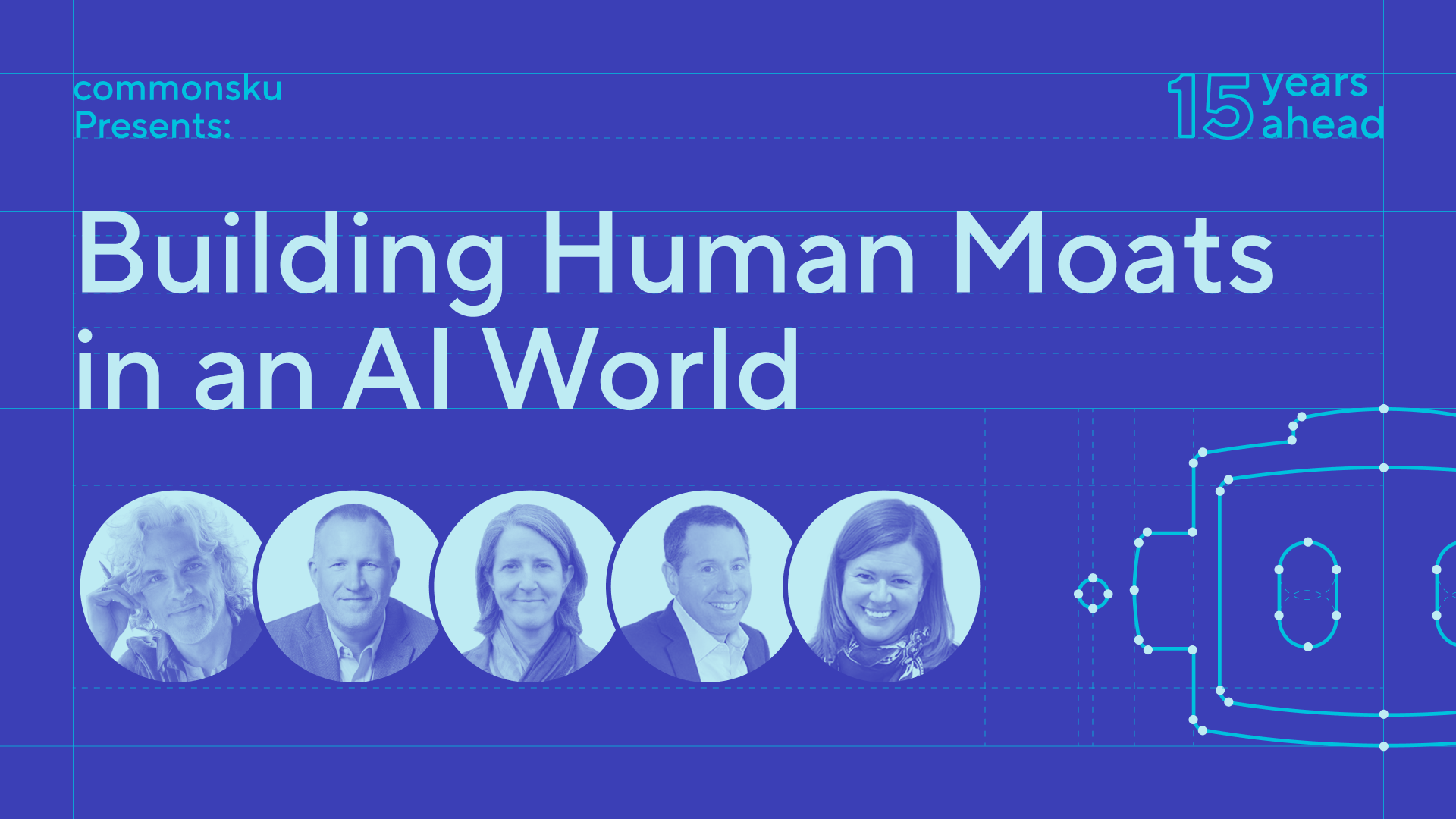
At commonsku Presents: 15 Years Ahead, our fifteenth anniversary event, we hosted two panels. The first took up the next era of the promo industry, with Drew Holmgreen of PPAI, Denise Taschereau of Fairware, Jonathan Isaacson of Gemline, and our CEO, Catherine Graham. The second, hosted by our VP of Marketing, Kara Parkinson, covered the next era of merch as a marketing channel, with Chris Staresinic of The Brand Entity Group, David Siekanowicz of 7 Communications, Maria Acquarola of commonsku, and Mikas Agarwal of Akran Marketing.-057.jpg?width=5760&height=3840&name=commonsku%20Presents%20(2026)-057.jpg)
Their answers about viability were surprisingly human: in a world that is blisteringly becoming bot-driven, it's our human qualities (not our data) that might be our most competitive moat. How should we prepare ourselves for this future? Here are five human moats our panelists uncovered and encouraged us to develop:
Radical Flexibility
We're not just experiencing change, we're experiencing volatility. Volatility is the speed, intensity, and magnitude of change. Denise Taschereau of Fairware notes that the coming years will not remove the distributor from the equation but will bring "a disappearance of mediocrity." She said, "It's the folks that are not willing to change and adapt that are gonna go away." We must build teams that know how to adapt but also "swerve and weave" through the mayhem. It's not just adaptability; it's agility plus adaptability: the willingness to change and the speed to change direction mid-order.
Flexibility is our new, human operating system.
Curiosity in Action
David Siekanowicz of 7 Communications shared one of the most powerful moats: curiosity in action. Stop guessing what buyers need; instead, embed yourself in their world. When David landed a beauty brand account, he didn't just ask for a brand standards doc. He drove 90 minutes to experience a treatment firsthand from the customer. That's curiosity in action and something only a human could do. His words: "I feel like I'm not going to be genuine to this client and this brand if I haven't experienced what all their customers experience." Likewise, Drew Holmgreen of PPAI said that distributors' clients might end up in three tiers: transactional, portfolio, and strategic. If sourcing was once the industry's sole strength, that magic is now shifting to brand strategy and strategy is rooted in curiosity.
Deep Empathy
We talk a lot about artificial intelligence, but what about the other forms of intelligence? Social intelligence, somatic intelligence, intuitive intelligence, perceptual intelligence. A great example came from David: emotional intelligence.
Make merch about the receiver, not you.
He gave us a great rule: When gift giving, "Don't show off how good you are at buying presents. Show off how much you care." This empathy also helps you protect your direct buyers, folks who need you to make them look good to their bosses; it's about the client experience most of all. Chris Staresinic of The Brand Entity Group stressed that great branded merch has to start with the recipient's daily life, not the brand's desire to plaster its logo on a product. And Drew Holmgreen said, while digital systems can analyze data and provide information, they can never replicate a sincere human connection.
Visceral Storytelling
Much of what fails in sustainability selling fails at one point: we cannot turn the data into a story. Denise Taschereau compared the raw material from supplier spec sheets to "reading a chemistry paper," safety reports and compliance documents that move no one. Data doesn't sell. Stories do. To move someone or protect a brand, you have to convert scientific complexity into a narrative a person can feel. Jonathan Isaacson of Gemline said the answer is "storytelling, by making it simple and emotional and understandable at a very visceral level."
Activate Joyful Liberation
For leaders, Catherine Graham said to use technology and automation to buy back time for you and your team. The true goal of automation is to strip repetitive, low-value tasks away from salespeople. This unburdens them, creating the mental space to focus on joyful, creative, and uniquely human work.
"We believe that work is gonna fundamentally change in the industry over the next 15 years, that AI and automation can enable us to spend time, more time on work that is joyful and, more importantly, time on work that's human."
Catherine Graham, CEO · commonsku
Stop enduring tech adoption; embrace it as a liberating tool that sets you (and your team) free.
Soft skills are now vital skills
Whether you're building your own career or leading a team, these aren't just soft skills; they're the human moats that make us irreplaceable. In addition to the above, our panelists cited intellectual candor, confident humility, and being comfortable with being uncomfortable. The future isn't about out-racing algorithms or out-consulting a language model; it's about doubling down on the one thing we can own: being so utterly human no machine can match it.
To wrap our panel, I asked each panelist to write a headline for our industry fifteen years from now. Here are their headlines:
What about you? What human skills would you add to this list? And if you had to write a headline for our industry, what would you write?
Watch 15 Years Ahead On Demand
Both panels, every prediction, and all four headlines in the panelists' own words.
Watch the Replay →Written by: Bobby Lehew, Chief AI Officer at commonsku.
He is also the author of The AI Promo Brief, host of the skucast, and a 25-year veteran of the promotional products industry.
RELATED RESOURCES