
 For Owners
 For Sales
 For Production
 For Finance
 Presentations
 Shops
Shops
 Product Mockups
 Client Portals
 Product Search
 CRM
CRM
 Decorator Matrix
 Suppliers
 Navigation & Dashboards
 Production Management
 Reports & Analytics
 commonsku Payments
 Essentials
 Advanced
 Enterprise
 Customer Stories
 Events
 Blog
Blog
 eBooks
 skucast (Podcast)
 Ask skucast
 Webinars
 ROI Calculator
 FAQ
FAQ
SECTIONS
RELATED RESOURCES

Merch Isn't Stuff, It's Media
For a lot of marketers, branded merch is still swag. It gets ordered in a hurry, requested two weeks before the conference, and forgotten about until the boxes show up at the venue.
I know, because that is how I treated it for much of my career. I spent twenty years in marketing at Apple, Intuit, Nestlé, and PepsiCo, and for much of that time merch sat in the transactional drawer with the things you handle by phone call and stop thinking about.
That thinking got rebuilt when I joined commonsku, and what rebuilt it was not a pitch. We're all seeing that digital channels are getting noisier and more expensive by the quarter. Merch (lucky for us!) is quietly doing the opposite, earning voluntary daily attention in a market where most advertising gets skipped, blocked, or ignored. A well-chosen physical object sits on someone's desk for two years and asks for nothing.
Merch is media. If you're mostly taking orders right now, that's not a character flaw, it's what happens when you're putting out fires. The panel gave four concrete ways to shift it, and they're below.
PPAI's own research says the shift is real but incomplete. In a March 2026 flash survey of PPAI 100 distributors, 47% reported that their end buyers now use merch as a core marketing channel on a regular basis. Yet only 21% of those buyers treat it as a core part of the marketing budget, and 41% still regard it as a nice to have. Half of distributors named difficulty proving return on investment as a barrier, and 61% pointed to pricing pressure limiting their flexibility.
Read those numbers together and the diagnosis is uncomfortable but useful. Merch is being used more strategically than it is being valued. Concern about relevance was near the bottom of the list, with most distributors disagreeing that buyers see merch as outdated next to digital. The gap is not whether this channel works. The gap is whether anyone can defend merch in a budget meeting.
-076.jpg?width=5760&height=3840&name=commonsku%20Presents%20(2026)-076.jpg)
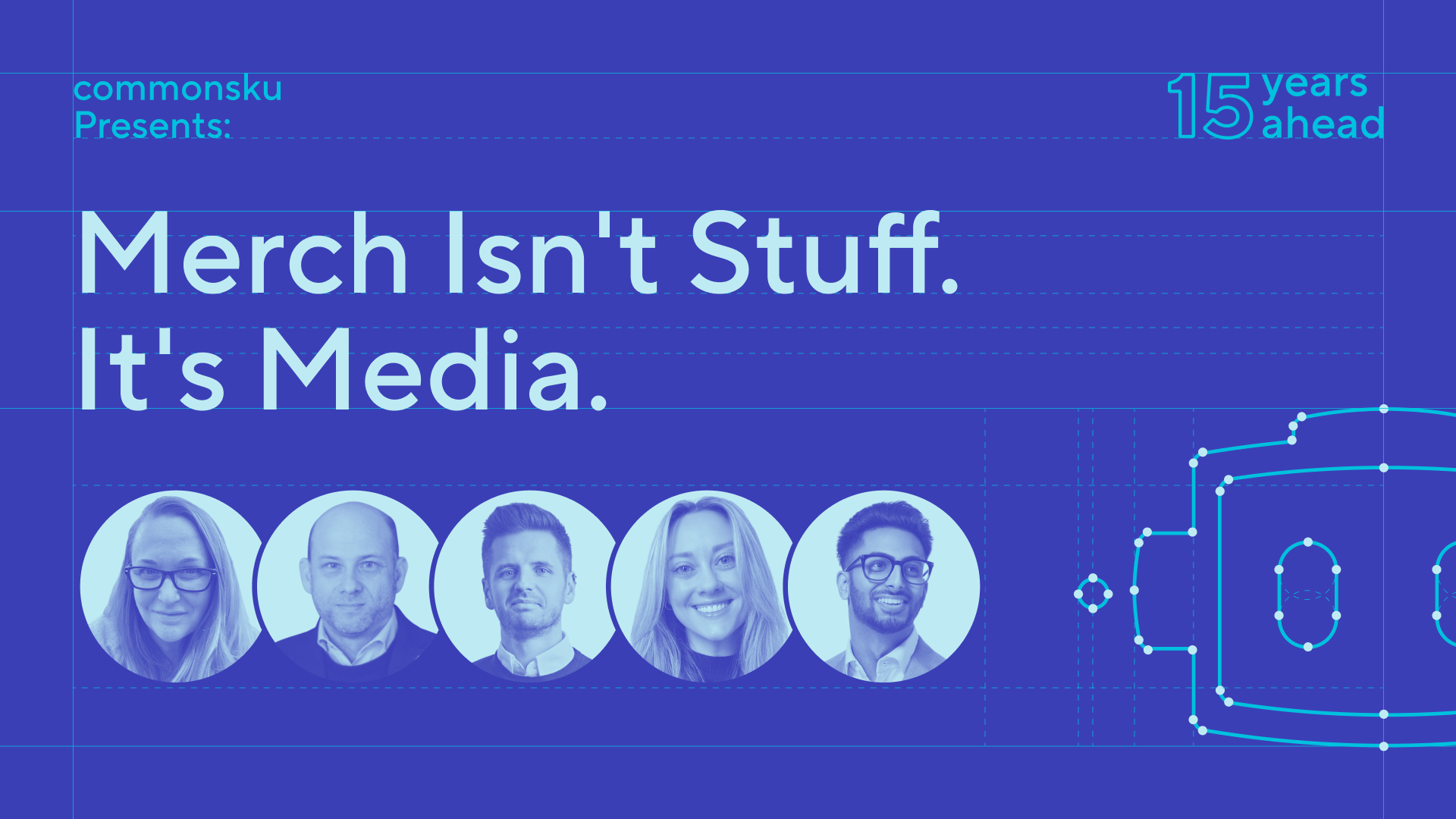
At the live recording of commonsku Presents: 15 Years Ahead in Toronto, I moderated a panel with four people who buy merch, sell merch, or study how this industry talks about itself. What struck me was how little any of them talked about products, and how much they talked about attention.
Here is what they said, and what to do with it.
Sell What Changes for the Person Who Gets It
Chris Staresinic was a founding executive at Campari Group Canada, where he spent a decade helping grow the business past $125 million in annual revenue and, at its peak, oversaw more than $3 million a year in point of sale branding. Every dollar of that had to earn its place. He is now a Partner at The Brand Entity Group.
When Chris briefed glassware for the Canadian launch of Aperol, he was not thinking about glassware. He was thinking about a person having a good night out with friends, and whether that same feeling could be recreated at home a week later. The glass was the mechanism. The memory was the product.
He also talked about what failed. His team once spent heavily on branded Bluetooth speakers when Bluetooth speakers were the trend, and discovered they stopped working more than a foot away from a phone. Thousands of units with the brand on them, out in the market, not working.
The conclusion he drew is worth repeating to any client grinding you on unit price. Quality beats quantity now, and the cheap piece that fails in the field costs the brand more than the good piece that lasts.
What to do with it: stop opening with what the item is and start with what changes for the person who receives it. David Siekanowicz, Director of Creative Strategy at 7 Communications, has a rule for this. Every brief his team writes describes the transformation, meaning what was true before someone engaged with the brand and what is true after. If your presentation cannot answer that question, you are selling a product and you will be priced like one.
The Brief is Your Way into the Room
I have written briefs for almost every kind of marketing work I have ever commissioned. I have never once written a brief specifically for merch. Neither had anyone else on that panel, and that gap is the whole opportunity.
David gave the clearest picture of what a useful brief looks like from the client side. Keep it short, because briefs that sprawl stop being read. Do not solve it for him, because he wants to state the problem and think through options with a partner. Describe the intended change in the recipient's behaviour or feeling.
In addition to his core agency work at 7 Communications, David has spent much of this year working with PPPC on their rebrand, which involved audience workshops and a hard look at how the industry is perceived from outside it. One thing he noticed is how often this industry opens defensively, leading with what merch is not rather than what it does. His advice was to go on the offensive when the work is good, and to be willing to name bad work as bad, because that is how the marketing industry earns its own credibility.
Maria Acquarola, now Outside Sales Director at commonsku after nearly a decade on the supplier side at Pop! Promos, pointed out how much gets lost further down the chain. Suppliers rarely see any brief at all. They get pieces of a story and are expected to quote against it.
What to do with it: ask for the campaign brief. Most marketers already have one written for the broader campaign, and almost nobody has ever asked them for it. Asking signals that you want to solve the problem they are actually measured on. That is how merch stops being handled at the end and starts being part of the plan.
Bring the Idea before Anyone Asks for It
Mikas Agarwal is Chief Digital Officer at Akran Marketing, the family distributorship founded in 1997 that he now helps run. He also made this argument in Forbes back in 2024, writing that promotional products are shedding the reputation captured in the old joke about what SWAG stands for, stuff we all get. And get this roughly half to sixty per cent of Akran's orders are fully custom.
His example was a luxury spa chain that asked for boxer briefs and provided Akran with no further detail. His father bought twenty different pairs at retail, shipped them to the client, and asked her to put a sticky note on the one she liked. They have been producing that exact piece for the chain's North American spas ever since. Other years have brought custom pens shaped like rifles for a Department of Defence recruitment campaign and baby feeding shirts for the Government of Nunavut.
Maria's version of this was blunter. Her advice to distributors was to be bold, not told. She used Starbucks as the case: a brand with famously tight guidelines, where someone pitched an entire collection built around the pink drink. It's an idea that sat outside the brand book, it worked, and whoever pitched it is now the first call.
What to do with it: Cast a wide net during your research, but filter the results before you step into the room. Keep twenty concepts in your back pocket and place only two on the table—each selected specifically because of a deep understanding of that client's goals. In a world of noise, everyone wants to feel known, and that curated focus is exactly how you achieve it.
Bring Them a Way to Measure It
This is the part I feel most strongly about as the owner of a full marketing mix and spend, and it is the reason merch so often ends up as leftover budget.
I can defend paid search spend to a CFO because I know what it returns. I didn't have that for merch, and it never occurred to me to ask for it. So it got funded last, out of whatever remained. That's the gap sitting open for you right now.
What to do with it: show up with a point of view on measurement. What does a good campaign look like, what should the client watch, and how will they know at the end whether the money was well spent? It does not need to be a perfect attribution model, but it needs to be enough that your client can put the number in a plan and answer for it later.
The good news is that the evidence now exists. PPAI's consumer study asked people whether they had ever taken action because of branded merch. Roughly 48% had looked up the brand, 42% visited its website, 39% bought something, and 38% talked about the brand with someone else. Only 13% reported doing nothing at all. On retention, close to 90% said they keep the merch they receive either regularly or occasionally.
Those are marketing numbers and they belong in your presentations! Alok Bhat, PPAI's market economist, framed the contrast in the June issue of PPAI Magazine by pointing out that "a billboard disappears when the campaign ends," while a well-made jacket keeps showing up at the office and the gym. That is the argument (supported by data) for you to position merch as media.
Both studies live in PPAI's premium research library, which is worth the membership on its own. The two most relevant are Merch In The Marketing Mix: Opportunities And Gaps For Distributors and Consumer Study: What Makes Branded Merch Worth Keeping.
Mikas has written about the most direct form of measurement there is, which is asking the people who received 'the thing'. Quantifying this category is hard, so ask the recipients directly. Did they keep the item or bin it? Did they use it the way you intended? A distributor who comes back six months later with those answers is doing something almost nobody in this category does, which is closing the loop.
Then, your next task is to time it properly. Most companies build next year's plan in the fall, which means the conversation that gets merch into the 2027 plan happens in October. However, Chris added a useful note here: Every team is planning their annual calendars, but almost no company is following them so precisely, that they wouldn't budge a little bit to make a strong idea work. If you pitch a creative, data-backed idea, with persistence, your clients can find the budget somewhere. So keep calendars in mind, but don't let them fully hold you back from pitching great ideas! He is also seeing purchasing decentralize again after a decade of consolidation, which means smaller and more local partners are being considered in a way they have not been for years.
Do Not Undo it at Delivery
Two frustrations from the panel came up, and both are trust problems vs product issues.
Chris described approving a prototype that was fine, then receiving ten thousand units that were not. Mikas described the client experience of setup charges, processing fees, and line items that surface late. Neither is a sourcing failure. Both are why some marketers still treat this category as something to be managed rather than a partner to be briefed. Positive, clear communication is key to managing this gap.
Getting invited into the brief is the hard part. Keeping the invitation is about what happens after the purchase order.
The One-Line Version
I closed by asking each of them for the single thing a distributor should change tomorrow.
Written by: Kara Parkinson, SVP of Marketing at commonsku.
She has spent her career at the intersection of brand and human behaviour, leading marketing at Apple, Intuit, Nestlé, and PepsiCo. Hear more from Kara on skucast episode 366, where she digs into how distributors can sell merch as a high-impact channel.
RELATED RESOURCES