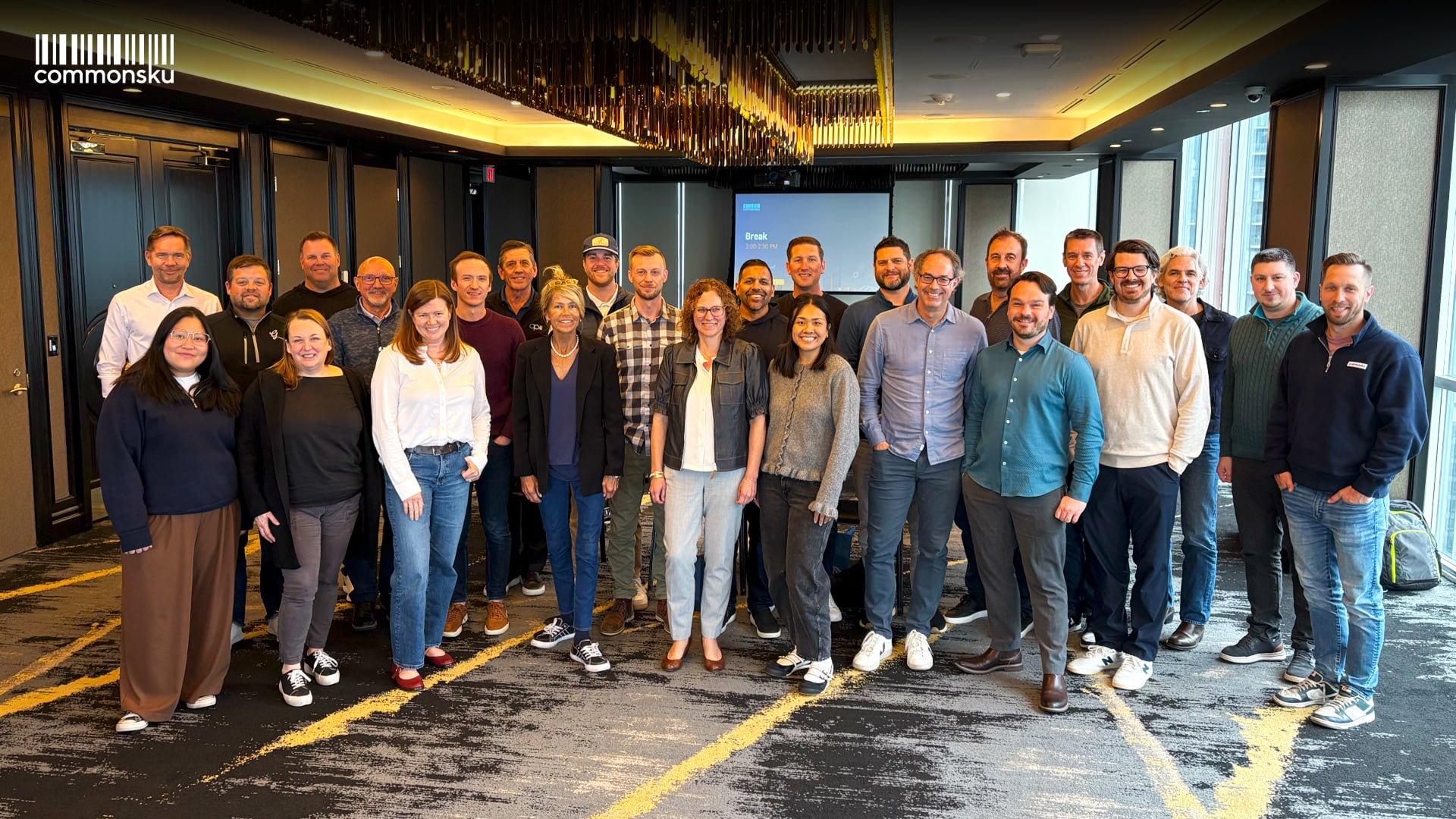
Last month, seventeen distributor CEOs gathered at commonsku's CEO Summit for a day of comparing notes on growth, margin, hiring, operations, and the topic threading through all of them: AI. The conversation that followed was honest, useful, and the kind worth carrying forward.
A Room of Operators
The Summit gathered seventeen distributorships across fourteen U.S. states and Canadian provinces. The room represented different corners of the industry: pure-play promo distributors, branded merch shops, apparel-led companies, event-and-activation specialists. Each one running a different shape of distributorship but each one asking versions of the same question.
Bobby Lehew, commonsku's Chief AI Officer, opened with the room's survey data. The headline: the room averaged 42% revenue growth in 2025, well above industry averages. That number set the tone for the rest of the day.
A New Shape of Distributorship
The room continues to view 2026 with optimism. Most plan to add headcount this year, not trim it.
One striking moment came on the question of company size. Some in the room believed a $10 million distributorship with five employees is realistic in seven years. A few years ago, that math would have looked different.
Bobby's read: "AI is probably the first technology wave that lets us grow without doubling headcount. Every previous wave usually started as a threat."
What Makes AI Stick
Aaron Kucherawy, commonsku's VP of Customer Success, opened the AI session with a single question: Who in the room had rolled out AI on their team and made it stick?
A few hands went up. The rest of the room leaned in.
The friction points the leaders named were familiar across the table: gaps in their own AI fluency, tools that hadn't taken root, the sheer volume of options, the question of which use cases actually map to their roles.
The survey data pointed to the opening. Thirteen of fourteen respondents are using AI for design: proof the industry has cleared the first hurdle. The next frontier is forecasting, operations, and the workflows that compound over time. AI use is wide; the depth is the opportunity.
Eku Malcolm, commonsku's Director of AI Operations, named what separates the teams that scale from the teams that stall:
"When you define the why, people keep coming back to the tool."
The teams that make AI stick start with purpose, not procurement. They tie the tool to a real problem, a real workflow, a real outcome. The why is the engine. Everything else follows.
What the Leaders are Doing Differently
Four patterns surfaced from the teams making AI stick.
Pick one workflow, not the ocean. The teams making AI work didn't try to "use AI." They picked one specific workflow and got it repeatable: proof follow-ups, pre-call account summaries, supplier description rewrites. Then they opened the next door. Most assigned an AI champion (curiosity over seniority) and gave that person time to teach the rest.
The middle 80%. Eku introduced a frame that landed across the room. Humans handle the first 10% (intent, context). AI executes the middle 80% (the volume, the repetition). Humans handle the last 10% (judgment, taste, validation). That framing sidesteps the "AI replaces people" fear and the "AI does everything" trap. It clarifies what AI is actually for in a service business: the middle, where most of a project's hours go.
AI Office Hours. One commonsku-internal practice transferred to most of the room. An hour a week, optional attendance, where team members share AI wins and AI failures. The failures are the point. They surface real use cases peer-to-peer and normalize experimentation. By the end of the day, several CEOs had committed to running their version starting the following week.
Your Data is the Moat. Eku's other line: "Your data doesn't need to be perfect. But it needs to be yours." Most distributors have years of structured workflow data already sitting under their Client projects: orders, POs, client history, supplier interactions. AI gets useful when it can read that context. Distributors with structured data outpace those working from scattered, tribal knowledge.
Looking Ahead
Closing the day, Mark Graham, commonsku's President landed on something that captured the mood:
"I would rather start a distributorship today than in 1997. The respectability of our medium has never been higher."
Coming from someone who has watched the industry for three decades, that lands. Branded merch is moving up the stack. Buyers are more sophisticated. AI is finally catching up to the actual complexity of the work. The distributors who treat their data as an asset and their point of view as a product are pulling ahead.
The honest conversation in this room about AI is part of that pulling-ahead. Naming what's working and what isn't. Sharing playbooks. Normalizing both the wins and the failures. That's how a room of operators stays ahead of an industry that's still figuring it out.
 For Owners
 For Sales
 For Production
 For Finance
 Presentations
 Shops
Shops
 Product Mockups
 Client Portals
 Product Search
 CRM
CRM
 Decorator Matrix
 Suppliers
 Navigation & Dashboards
 Production Management
 Reports & Analytics
 commonsku Payments
 Essentials
 Advanced
 Enterprise
 Customer Stories
 Events
 Blog
Blog
 eBooks
 skucast (Podcast)
 Ask skucast
 Webinars
 ROI Calculator
 FAQ
FAQ