
 For Owners
 For Sales
 For Production
 For Finance
 Presentations
 Shops
Shops
 Product Mockups
 Client Portals
 Product Search
 CRM
CRM
 Decorator Matrix
 Suppliers
 Navigation & Dashboards
 Production Management
 Reports & Analytics
 commonsku Payments
 Essentials
 Advanced
 Enterprise
 Customer Stories
 Events
 Blog
Blog
 eBooks
 skucast (Podcast)
 Ask skucast
 Webinars
 ROI Calculator
 FAQ
FAQ

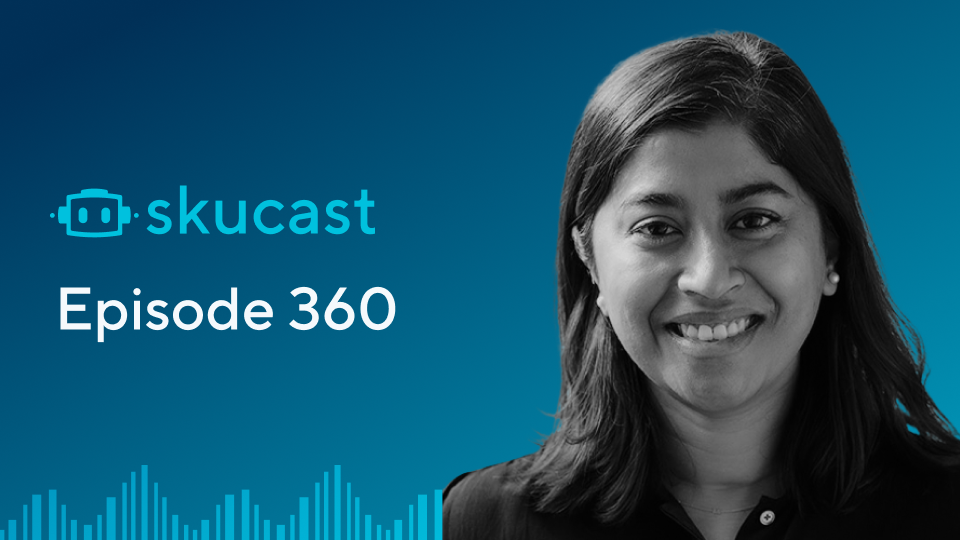
Episode 360: Behind the Code with Dileshni Jayasinghe
No video selected
Select a video type in the sidebar.
You click a button in commonsku. An order goes out, a presentation saves, a tax calculation fires. It just... works.
You don't think about it. You shouldn't have to.
But somebody has to. That somebody is Dileshni Jayasinghe, commonsku's VP of Technology. She leads the engineering team building the system over 900 distributors rely on daily. Before commonsku, she spent 7+ years at PagerDuty and built scalable systems at Instacart and FreshBooks across a 15+ year career.
On today's show, she pulls back the curtain on how commonsku gets built, the AI tools her team uses every day, and what's coming next from skubot.
The Invisible Cascade
When you submit an order, one click triggers a cascade of backend services. Tax calculations route through Avalara. PromoStandards calls pull live supplier data. States save across databases. If something breaks, the system surfaces it without leaving you stranded. Dileshni manages five product teams plus a platform team handling AWS, databases, and reporting. The promo industry's web of products, integrations, and workflows makes this a uniquely complex engineering challenge.
From Months to Days
Building a new feature used to mean a requirements doc, three to four months of dev, then ship and hope nothing changed. That cycle has collapsed.
Dileshni's team now builds proof of concepts fast, tests with trusted customers, and deploys to production daily. Most were on VS Code before. Now they use Cursor (the AI code editor that just crossed $2 billion in annualized revenue), GitHub Copilot, Claude Code, and CodeRabbit for automated code reviews. Point Cursor at a codebase and it gains context. One engineer built an entire monitoring system for commonsku's health, consolidating server data into one dashboard, in days rather than weeks.
"There always needs to be a human in the loop."
— Dileshni Jayasinghe
What's Coming to Your Dashboard
The vision: tell skubot what a client needs. It handles product selection, configuration, pricing, and mockup generation to get a presentation most of the way built. You make it yours and send it.
Some of that is already real. commonsku has shipped the AI Recommendation tool to all users. The skubot AI Mockup Generator is in beta, reading your decoration settings, client art, and Connected+ supplier data to render branded visuals without leaving commonsku. Next: the skubot Opportunity Bot, flagging cross-sell patterns you're probably missing. Further out: a description rewriter and art configuration assistant. (Full AI features update | 2026 roadmap)
Why AI Isn't Killing SaaS
Dileshni isn't buying the "SaaS apocalypse" headlines. The tech industry has been through these cycles before. Companies that adapt come out stronger. The ones that don't were already stalling.
What excites her is who gets to participate now. At commonsku, customer success and product team members use Cursor to navigate the codebase, answer customer questions, and build queries without waiting for an engineer.
"Someone with a great idea can now build a proof of concept without a computer science degree."
— Dileshni Jayasinghe
Features that once took months now ship in days. The AI heading to your dashboard is built by a team that already lives and breathes these tools. The gap between "we had this idea" and "it's in your hands" keeps getting shorter.
In this episode, we also discuss:
- Vibe coding vs. AI-assisted development, and why the distinction matters
- Spotify's bold AI claims and whether they're signal or noise
- ExploreTech TO, the organization Dileshni co-founded to develop diversity among tech speakers in Toronto
- How commonsku's non-engineering teams are using AI tools to resolve customer questions faster
→ Want to see how commonsku runs your workflow?
Book a demo
Show Notes: Key Timestamps & Topics
[00:02:35] Dileshni's role at commonsku
[00:03:43] Engineering team structure
[00:08:51] The journey of a new feature
[00:11:44] Vibe coding explained
[00:12:27] Spotify's bold AI claims
[00:14:27] Cursor, GitHub Copilot, and Claude Code in the daily workflow
[00:18:40] skubot, Mockup Generator, Opportunity Bot
[00:19:43] The so-called SaaS apocalypse
[00:22:53] Democratizing access to code
Frequently Asked Questions
What happens behind the scenes when you submit an order in commonsku? +
What AI tools does commonsku use to build its software? +
What is skubot and what AI features is commonsku building? +
Is AI going to replace SaaS platforms? +
How is commonsku's AI different from using ChatGPT or Claude? +
Bobby Lehew is Chief Content Officer at commonsku, host of the skucast, and a 25-year veteran of the promotional products industry.
🎙️ Read Full Episode Transcript +
[00:00:00] Music Intro
[00:00:06] Bobby: As you already know, a seismic shift is taking place in technology right now. AI is changing how software gets built, how fast it ships, and who gets to participate in building it. And every platform you rely on to run your business, including commonsku, is being shaped by these market forces, even if you've never written a line of code in your life.
This episode matters because it's a peek behind the scenes at how commonsku in particular is changing, adapting, and growing in this new world. Welcome to the skucast, the podcast for innovators and maverick thinkers in the promotional product space. My name is Bobby Lehew. I'm glad you're here.
On today's show, I am thrilled to welcome Dileshni Jayasinghe. Dileshni is commonsku's VP of Technology, and she just crossed the one-year mark leading our engineering team. Before commonsku, Dileshni spent over seven years at PagerDuty where she rose to Director of Engineering for Runbook Automation. Before that, she built scalable systems at Instacart and FreshBooks, racking up over 15 years in the craft.
She is also a very strong community contributor. She co-founded ExploreTech TO, an organization dedicated to developing diversity among tech speakers in Toronto. Join us as we talk with Dileshni about what software engineering actually looks like day to day and what happens behind the scenes every time you click a button in commonsku, plus AI coding tools like Cursor, and how our engineering team is using AI right now to build features faster and solve problems in ways that weren't even possible a year ago.
And why Dileshni believes that this is the most exciting time to be in software, and how AI is opening doors for more people to participate in building tech than ever before.
[00:01:30] Today's episode is brought to you, courtesy of us at commonsku. Over 900 distributors powering 1.8 billion in network volume rely on commonsku's connected workflow. Process more orders, connect your team, and dramatically grow your sales. To learn how, visit commonsku.com.
Oh, one quick note. My mic decided to take the day off for this one for some reason, so I'm on headphones. Audio's not quite up to my usual standard, but the conversation more than makes up for it. Here's my chat with Dileshni.
[00:02:07] Bobby: Hi, Dileshni. Welcome to the skucast.
[00:02:09] Dileshni: Thanks, Bobby. Thank you for having me.
[00:02:12] Bobby: We are so honored you are here. We are gonna jump right into the middle of this conversation because I have too many questions. As I mentioned in the intro, we wanted to invite you on because so much is happening with tech, so much is happening with AI. For people that might not think about this stuff every day, can you describe your role at commonsku as VP of Technology? What do you do? What does that actually look like?
[00:02:35] Dileshni: For sure. So the VP of Technology, there's like three facets to my job when I describe it to people. It's technology, people, and process. So the technology aspect is my teams and I build the software that runs commonsku as a product, which means looking at new tools that are coming in, keeping up with the AI tools, providing functionality to customers, and also making sure we build maintainable, scalable software, which is always changing.
And then there is the people aspect, you know, managing people's careers, their growth, all of the engineers, hiring, all of that happens as part of my role as well. And then the last piece is process. We don't build software and just say, "Oh, we'll build it and people will come." There's always other aspects of working with other departments, right? In terms of if we build a feature, maybe there's something a customer wants to give us feedback on. There's process around that with how we handle escalations with customer success, how we handle building new features with the product team, how we handle incoming requests from the sales team. So there's a process around how best to set up our teams for success, and that's a big part of my job as well.
[00:03:43] Bobby: You mentioned the word "teams" a few times. How is the commonsku engineering team structured? And then I just have a really basic question — what's the difference between a developer and an engineer, and what kind of teams work underneath you?
[00:03:55] Dileshni: So that's a good question. I think it depends on where people are coming from. So if you're in Canada, we legally cannot call ourselves engineers unless you have a professional engineering degree. But in the rest of the world, the software developer title has transitioned into software engineer because we do tackle like little bits of figuring out how a machine works and getting it to optimize the way we want it to work. Not necessarily needing a professional engineering degree, but doing more of the computer science or computer engineering as an undergrad kind of thing, if that makes sense.
[00:04:33] Bobby: It does. So developer might be a bit of an outdated term.
[00:04:36] Dileshni: Yeah, I think it was about 10 years ago when the tech industry as a whole started transitioning to the title of engineer. I remember this because I was one of the few that was just like, "Hey, you know, we legally can't call ourselves engineers." And I remember back then my boss saying, "Understandable. But at the same time, this is the title we have to use," especially in companies where we were hiring people from the States or from Europe. We needed a title that worked across all of these countries, and engineer was the one that we ended up with.
[00:05:08] Bobby: So we'll continue using the word engineer from now on in this chat. This is a really good segue into how software has been traditionally built, because you said 10 years ago we've seen this evolution of the role, even just the way the name, the nomenclature around what it's called. If someone has never thought about how software actually gets made, how would you explain what code is and what an engineer does?
[00:05:30] Dileshni: Yeah. So I think it's evolved so much. Before, let's say 20 years ago, the type of code we wrote was so low level that we had to figure out how it worked with the memory and the CPU, and we had to know all these intricate parts of a computer and how best to utilize it to do what we wanted it to do. But there's so many layers that have been developed now that most engineers don't necessarily need to know the nuances of how to utilize the CPU or how to manage the operating system or how to finagle memory. The coding language that we use has kind of abstracted that away so we can focus more on solving the customer problems or business problems and translating that into code.
So that's kind of where software is right now. But at the end of the day, what we're doing is the same as what we've done for decades. We are looking at a customer problem, we're taking that into requirements, and building software that will actually solve that problem.
[00:06:37] Bobby: When a commonsku customer clicks a button to create a sales presentation, or they submit an order, what's happening behind the scenes that they never see?
[00:06:46] Dileshni: Yeah, so there's multiple layers. There's the front end, which is what most users are gonna look at, right? The UI. But then there are calls made to the backend. We have multiple services running in the backend, which might be a call to click an order. That order means there's multiple other calls under the hood that get triggered, like maybe to calculate your taxes, to save the state of your order, who it's going to. It might need to call external services. For example, with commonsku, a majority of our customers are using Avalara as their tax calculation, so we might call Avalara. We might call the supplier information from PromoStandards to get information about the product to make sure it's the most up to date. So there's multiple layers happening.
And then we have to save the state of all of these layers in our database, and as you can imagine, it could go wrong in any of these layers, and we have to handle that in a very user-friendly way so that our customers know if something did go wrong, what do we need from them for the next steps to unblock them.
[00:07:49] Bobby: What I can imagine is this industry is already a very complex industry. You came in and you had to learn all the different nuances around this industry. It was already complex from a user perspective — and I'm putting myself in the shoes of the distributor or customer. It was already a complex industry, but you add the complexity of the technology on top of it, and what we've built is a workflow. You just mentioned these different calls — we have the supplier network and distributor. What are your thoughts about the complexity of all of this?
[00:08:16] Dileshni: I think that's what I love about this job, to be honest, that it's such a complex domain. Some software industries, that domain can be very simple, but the technology might be complicated because you have to deal with higher throughput. But with commonsku, I find the domain is so complex — the different touches that we have, the different integrations that we need, the different actors that are playing within our system is so complex. So it makes it challenging, but also it's really interesting problems that we get to solve as engineers every day, and that's part of what I really love about my job.
[00:08:51] Bobby: Walk us through the journey of a new feature, from initial idea to something a customer would actually click on. You have structured teams that are working on various aspects of it. There are Shops teams, there are different teams that work on things. Can you sort of walk us through what that journey looks like for you and your team?
[00:09:07] Dileshni: Yeah, so my teams are structured based on the product. Each product line has a team, so we have about five teams that way. And then we have a horizontal layer, which we call our platform team, which provides data capabilities and infrastructure capabilities. So they build our AWS infrastructure, our databases, making sure that they're scalable. And then the data warehouse where we get reporting data for internal as well as external reporting. So that's how the team is set up.
So usually when a new feature comes in, we work with the product team on what it is. It's really trying to understand the customer problem that we're trying to solve. We don't write a line of code — we're just trying to understand the customer problem, and we kind of brainstorm different ways we can solve it. Sometimes we can solve it with existing functionality that we have or making slight adjustments to it, or sometimes it's something brand new that we haven't tackled before.
[00:10:00] And all of this is where AI has been super helpful, because when I started in the industry, we had such a waterfall approach. We would have a product manager that went and wrote a long requirements doc. Then engineers would take it and go away for a few months and develop a feature. Then we would release it. So much time had passed between when we talked to the customer first and when we built this feature, which could be three to four months. And when we released it, maybe the industry had changed, maybe the customer requirements had changed.
But with us being able to leverage AI tools, we can actually build these loops a lot faster. We can build proof of concepts a lot faster, make sure this is actually what customers want. We have this trusted customer cycle that we can test out these POCs with. Like, "Hey, is this what you wanted to solve this problem? Or are we totally off base?" And then we can iterate quickly. And my team has set up our deployments in a way where we can deploy to production every day so we can incrementally ship value to our customer rather than having to wait that big, long three-to-four-month block.
[00:11:04] Bobby: Well, what sparked this whole "let's talk with Dileshni" conversation was AI and what we're about to get into now. I can only imagine your world. I'm just trying to keep up with it from a consumer's perspective and someone who's using it for content, which is generative AI, and that's so different. I can only imagine what your world looks like now. So we're gonna jump into AI and I'm gonna ask some really basic questions on behalf of our audience. But there's this term that's exploded called vibe coding. It's sort of now almost fading away, but it created this conversation around — for anyone who hasn't heard it, how would you explain it from your perspective as someone who's a pro in this business?
[00:11:44] Dileshni: So I would look at it in two different aspects. That's the way I've kind of understood it. So vibe coding — there is the aspect of, "I just work with an AI tool that generates all the code I need to build whatever it is that I'm trying to build." So I don't need to know how to program, I just need to tell it what it is that I'm trying to do. And then there's the second aspect, which is what a lot of software engineers use it for, which is an AI-assisted way of developing features.
Back when I started in the industry, pair programming was very big. It still is — when you run into a problem and you can't figure it out, you can partner with one of the other people on your team and you work on it together. Now you can do it with the AI tool, which is similar to what vibe coding is.
[00:12:27] Bobby: So Spotify's co-CEO just said their best engineers haven't written a single line of code since December, that they're directing AI from their phones on the morning commutes. That sounds so sensational. Some of the stuff is so hard to sift signal from noise with a lot of this AI news coming out. Is that sensationalism? Is that closer to the truth? What does that really look like?
[00:12:48] Dileshni: I mean, I read the news when he also mentioned this and name-mentioned a system under the hood called Honk that they've built internally that enables them to, you know, when a bug comes in, generate a bug fix quickly and deploy. There's very little information about this Honk system. So to me, it comes off as stretching the truth a little bit, because at the end of the day, we can have AI generate code, but you need to review it, make sure that it didn't just hallucinate, make up something.
At the end, we are the experts telling it what problem to solve, what data to use, what we're trying to actually get out of it. AI doesn't have the capability to make those decisions just yet. That's what I've told my engineers as well. You can leverage AI tools — I think everyone should be leveraging AI tools to help us with our day-to-day software development — but at the end, there needs to be a human in the loop to review what is being generated before you ship it to production. You have to make sure we can roll it back if it's wrong.
[00:13:53] Bobby: So you kind of answered my question. I was gonna ask about the difference between AI helping an engineer write code faster versus AI actually replacing what engineers can do. But let's talk about Cursor a little bit — how your team is actually using AI in their day-to-day work now. Can you give an example of the tools the team is gravitating towards? Cursor, and for those who don't know — you can explain it better than I can — but it's an AI-powered code editor, as I understand it, being actively used by our team for coding. Can you speak to what that is and also maybe what life was like before something like Cursor and life after?
[00:14:27] Dileshni: Yeah, for sure. All of the engineering team currently is using either Cursor, GitHub Copilot, or Claude Code. We've kind of gone with a method of "use the best tool for your job." Majority of them are using Cursor, which is good because then we can actually help each other and get the best out of that tool.
So in general, Cursor is a code editor. Majority of my team was using something called VS Code beforehand. So Cursor looks the same, behaves the same, except when you point it towards your codebase, it can gain context to your codebase. So let's say I want to ask a question about the codebase. I'm trying to resolve a bug about tax calculation for Shops. Historically, I would have to go through the code, read it, understand it. Maybe I wasn't the one that wrote that part of the code — I would have to go ask the teammate who wrote it. But now I can use Cursor to help me navigate and understand my codebase, but also to generate code.
For example, we built a lot of internal tooling that will help our customer success team as well as our internal teams. So what I was able to do was use Claude Code and point it at an existing tool and say, "Hey, I want to build this new tool which will enable our customer success people to restore a purchase order in case it was accidentally deleted." So this AI tool is now able to look at what are the patterns that were used in the past, and then I can build it similarly. And what you do is build it incrementally so that you can verify what it's building is actually what you want it to do. So that's kind of the overall how we're leveraging AI tools, but we also leverage it to build AI features as well.
[00:16:06] Bobby: Can you give us an example of something your team built or shipped recently where AI played a really meaningful role? And maybe that's something we didn't see as a customer. Maybe it's something behind the scenes.
[00:16:17] Dileshni: Yeah, a lot of it may be behind the scenes. So one of my engineers recently, Priyank — he's on the DevOps team. We have an observability tool that we use called Datadog. We wanted all of our logging to be consolidated into Datadog, which sounds very simple, but under the hood it means building a lot of pipelines, consolidating our server logs, our error logs, our temp logs — consolidating all of that, creating a pipeline, sending it to Datadog. And we don't set up all of these tools manually — we use infrastructure as code to set it up, which would usually take a couple of weeks for us to do this. But he was able to leverage Cursor, pointed at existing infrastructure as code, and set up this pipeline within a few days actually.
So now we have all of our observability tools and logs in one place. If something does go wrong, the engineers only need to go to Datadog, or the customer success team can go to Datadog and use all of the metrics that we have there to help solve a problem. And yeah, we use it every day to increase our test coverage, to build new features.
[00:17:25] But the biggest thing has been we make sure that we review it with a human and we also make sure that we have enough guardrails so that if something does fail, we can always roll it back.
Oh, and another thing that we use AI tools for is called CodeRabbit. One of the biggest blockers in software development is the code review.
[00:17:47] Bobby: Code review?
[00:17:48] Dileshni: It's a good question. So let's say I'm working on a feature. I make some code changes. Before I can merge those code changes into production, I need to get one of my teammates to review it to make sure I haven't missed something. It's actually a compliance requirement as well. But that's one of the biggest bottlenecks because, you know, my teammate might be really busy working on something else.
So we use a tool called CodeRabbit that gives us that initial code review. It's an AI tool that looks at your code. It knows the standards that we want to use within our engineering team and our codebase, and it'll give feedback based on that. So the engineers now have that first set of code review by the AI tool, and then the second by a human, and it's actually much better than just having one person review it. So we've been using that for about six months now.
[00:18:40] Bobby: Yeah, that's cool. Wow. We have a few AI priorities in development on the roadmap. We have AI Product Search, which we've shipped. skubot. AI Mockup Generator, which is in beta. We have skubot Opportunity Bot coming, a Description Rewriter, an Art Configurator, Presentation, Shop Builder. Where else on the commonsku platform are you most excited about AI? And maybe it's not even on the front of the platform — it can be something behind the scenes that's gonna accelerate processes.
[00:19:10] Dileshni: Yeah. As an engineer, what I want to do is to build software that makes a difference for my customers, right? And so I think that's where I am excited to see where we can use the skubot tools, like with the Opportunity Agent, with the Mockup Generator. Will this enable our customers to save time to focus on growing their business versus a lot of the manual work that they have to do? And that's where my team and I are really excited to leverage these AI tools and can't wait to ship some of these features that you just mentioned, which we've been in the works on for a little while now.
[00:19:43] Bobby: I would be remiss if we didn't talk about this topic because it's such a big topic in the news. There's been a lot of talk about the so-called SaaS apocalypse. Some smart people are arguing that the real threat isn't AI replacing platforms like commonsku, it's AI reducing the number of people who need to use them. What do you make of this whole conversation around the so-called SaaS apocalypse?
[00:20:05] Dileshni: I think it's overblown, to be honest. The tech industry has had times when something new has come in and we've all had to adapt to it. As an industry, it's all about adapting. That's what my career has been. Some new tool comes in — you know, I used to use Vim to write code before, and then IDEs blew up and I had to adapt to that. To me, it's the same. It's a new set of technology, a new set of capability. It actually allows more people to be able to understand code and build code, which I think is very exciting to me personally.
Then us as a business and as a team has to evolve to adapt it. Historically, there are companies that haven't been able to adapt to new technology or new ways of working, and I think that's what this SaaS apocalypse is about — the people that may not be able to adapt. But for companies that are able to be nimble, provide more capabilities, adjust our business, I think it will continue to grow.
[00:21:12] Bobby: As we wrap up here, you've been writing code for over 15 years. What excites you most about how AI is expanding what's possible in your craft or with your team?
[00:21:23] Dileshni: The thing that has excited me the most in the last few months is democratizing access to the codebase. Before, if there is a bug that comes in or a small issue, it always depends on the engineering team to fix it. But in the last few months, we've actually given access to our customer success team and product team. They can use Cursor and our codebase to navigate, to understand why a certain feature was set up this way, or how a feature was supposed to behave, or even simply like building one-off queries to help customers with some report they wanted to pull or a data pull.
I love that because it's giving people more tools to help them succeed in their jobs and the engineering team is not becoming a bottleneck. I think that's really exciting. And with these tools, like the AI Mockup tool and such, it's helping us look at creative ways to help our customers. I mean, that's really exciting to me. We're going from — a lot of SaaS tools out there are simple CRUD apps, is what we call it. It's create, read, update, delete.
But if you want to survive in this world, you have to have capabilities that are more than that. How do we help our end users grow their business? How do we help them save time or money or whatever it is? And being able to leverage a lot of these AI capabilities to do that is really exciting to me.
[00:22:53] Bobby: You mentioned in the intro, you co-founded ExploreTech TO to promote diversity in Toronto's tech community. And by the way, that's an amazing — you're so humble — it's an amazing organization, the work you've done behind the scenes. How do you see AI opening doors for people who haven't traditionally had access to building software?
[00:23:13] Dileshni: Yeah, I think this is a little bit related to what I had done a few years ago as well. Traditionally, people who were in engineering roles were people who went to computer science for their undergrad. And then I think about 10-ish years ago, we opened it up to people who went to bootcamps. And honestly, a lot of people that I've worked with that are really talented engineers don't come from traditional computer science backgrounds.
And I believe this boom of AI coding tools with Cursor, Copilot — it's enabling more people to solve problems with technology and to be able to write code without necessarily needing to have this deep computer science background. I think that is super exciting. Maybe someone has an idea and they want to write a proof of concept, and they are able to do that with Cursor or with Claude Code now. Maybe not necessarily writing enterprise-level software, but as a small proof of concept, they can get started with that. And I think that's really exciting and it gives more people opportunities.
[00:24:18] Bobby: The last thing — I get to work with you frequently and I always enjoy it. I love that you are such an extreme problem solver, that you enjoy so much of that part of your job. But thanks for joining us on the skucast.
[00:24:29] Dileshni: Well, thank you, Bobby. This was very fun and thank you for having me.
