[]
[00:00:00] Bobby: At commonsku, we've been rolling out some of the biggest platform development changes in our history, from finance and payment updates to powerful new presentation tools to our just-released AI Connected+ product search. The platform is evolving faster than ever. And on today's show, we're diving into what's live now, what's coming next, and how these changes will transform the way you run your business.
[00:00:20] Welcome to the skucast, the podcast for innovators and maverick thinkers in the promotional product space. My name is Bobby Lehew. I'm glad you're here. Charlie Moscoe is our VP of Product Marketing, and Charlie joins me today to cover a few things: new finance, payment, and automation tools, fresh presentation and reporting capabilities, the launch of our exciting new AI Connected+ product search, what's next for performance and reliability on the platform, and the future of commonsku for Advanced and Enterprise customers.
[00:00:48] Today's episode is brought to you, courtesy of us at commonsku. We are the workflow platform built by promo industry experts. We combine CRM, order management and collaboration tools in a [00:01:00] fast, simple solution, and over 900 distributors, plus the industry's most reliable suppliers, rely on commonsku to power $1.8 billion in network volume.
[00:01:09] Work smarter, connect your team, and grow your sales. Learn more at commonsku.com. Now here's my chat with Charlie.
[00:01:16] Bobby: Let's talk about core features recently shipped and coming soon. So what are some recently shipped features customers might have missed?
[00:01:22] Charlie: Yeah, so there's a bunch of great things rolling out on the core distributor workflow. Two big ones that we've shipped in the last few months that are getting great adoption across the distributor base are new tools for more flexibility in payments and payment processing. The first is a long-requested feature to pass through credit card fees on invoices paid by credit card.
[00:01:43] So this is a feature that allows the distributor on a global basis—so what's your default—and then also project by project, to decide whether or not the client is responsible for paying that credit card fee. Alongside that, we have a feature we shipped a little while ago to allow customers to pay by ACH, and that fee is dependent on the [00:02:00] payment method.
[00:02:00] So if the customer chooses to pay by credit card because they want the points or they want to defer payment a little bit, they can do that and choose to eat the configurable fee. And the percentage there is also set by the distributor. Or they can have their customers pay by ACH, which allows them to have that lower fee out of the gate for both sides, and have no one really need to deal with it.
[00:02:22] Bobby: The updated presentations feature has been in beta for a while. What's the feedback been like and when do you expect to roll that out broadly?
[00:02:28] Charlie: Yeah, that's a really great point. That feature has been in beta for over a year, which is a long time by our standards. The initial feedback on it in the beta was, "This is awesome. We love building these amazing interactive presentations. We love being able to bring more of our brand, more of our storytelling to our presentations using all of the cool UI work that we've been doing in shops over the years."
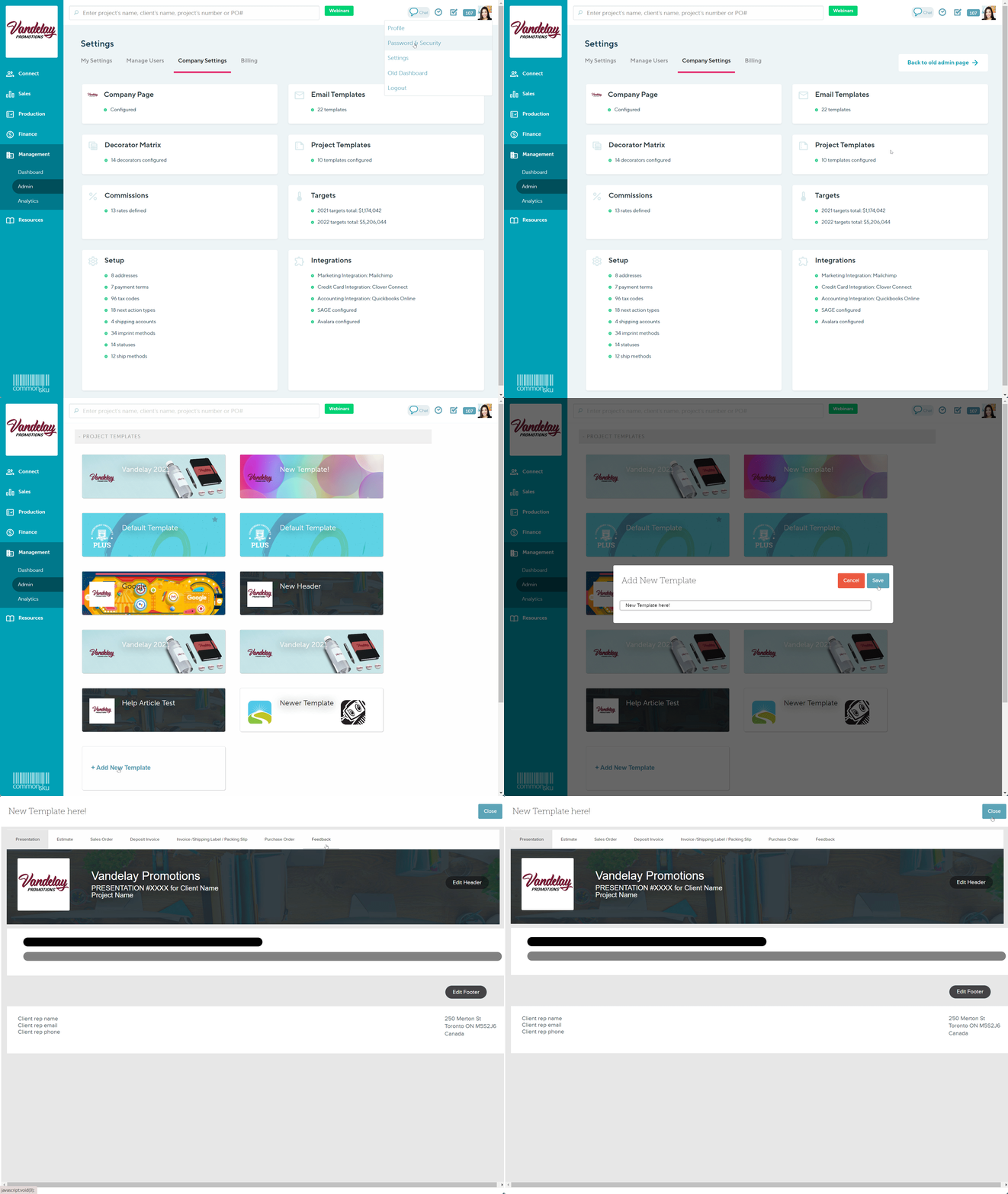
[00:02:48] The new feature basically lets you use any of our shop layouts as a presentation and build really beautiful presentations for your customers. The feedback though was that it was a lot of work to do every time you were putting together a [00:03:00] presentation, and that the distributors needed a way to save basically the design and then roll that out either for every presentation for the client, or just have your amazing set of default presentation templates for your business and roll those out to all of the customers.
[00:03:13] So what we did there was we spent a good chunk of time this year building a templating system, which rolled out first for shops, but also functions in the new presentations. And we've now rolled that out to everyone in that presentations beta, along with 40 new distributors trying it out. And with that new addition, it's really becoming the beta user's preferred way to put together commonsku presentations.
[00:03:32] It's really flexible. And now you can have your sort of most design-forward employees, whether that's a designer or just a rep who's really good at building beautiful presentations. They can put everything together and then you can use that across all your projects. So the feedback's been really strong the past few weeks, and we think it'll be rolling out widely in the next couple of weeks.
[00:03:49] Bobby: This is a fantastic point to talk about, or a moment to talk about beta, because a lot of folks may not realize that when we develop things, we're developing this in tandem with customers. So talk to that a little [00:04:00] bit. You have 40 people in beta right now. That's a pretty good sampling size. Tell us how the beta process works a little bit.
[00:04:06] Charlie: Yeah. So when we have a great idea for a new feature, sometimes it's something that a customer submitted through the idea form. Sometimes it's something that we've come up with as what we think the next step of the industry might be. Our process is, first, we work with customers to validate the design.
[00:04:20] So we'll put together a specification. Our designers will build out what it might look like. We tend to show those to a couple of users. If we get good feedback on that, then we go and build the first version of the thing. And when that's done, when it's been through our internal testing, and we're pretty happy with it, and we think it does the thing that the feature is supposed to do, that's where we look to do a beta test.
[00:04:40] So a public beta is a test with a small group of customers to make sure that the functionality is as expected, so that when we roll it out to all of the customers, we don't have 500 distributors reporting the same problem, kind of thing.
[00:04:51] Bobby: Yeah.
[00:04:51] Charlie: When a feature's ready for beta test, the product manager from my team will make a post on the Community Forum saying, "Hey, we want to test out credit [00:05:00] memos and vendor credits. If that's a feature that you think will help run your business, you can put your hand up and you can get early access to the feature in exchange for it maybe being a little rough around the edges." And everyone who was in that presentations beta basically did that a year ago. And they've been providing us feedback on what's working, what's not working. That's an example of where we got some feedback that this is potentially cool, but needs some additional lift.
[00:05:21] So that's why that one was relatively long-running. Some of our other features spend maybe a week in beta if we put it out there and everything's just working and everyone's happy with it and it can just go. So that's the process there.
[00:05:32] Bobby: Okay. Thank you for that. Finance updates are always sensitive territory. What's new there?
[00:05:37] Charlie: Yeah, so a lot is new there. And it is very sensitive territory. So that's another one that we've had in a public beta with many customers for a couple of months now. What we're doing there is basically rebuilding the entire finance portion of commonsku, and that is everything from the API we're using for QuickBooks, Xero, and other accounting integrations, which has been restructured from the ground up and will let us do a bunch [00:06:00] of cool new things going forward, straight through to the interface that lets our customers interact with those invoices, bills, and now credit memos and vendor credits within the commonsku application itself. So the team's been working really hard on that. And the cool new functionality coming there is a couple of things. So one, those vendor credits and credit memos are awesome tools for correcting projects where something may have gone wrong and there may be adjustments on the client side, vendor side, or both, that need to be taken into account for accounting and for commissions purposes.
[00:06:28] And the other piece that's extremely exciting is we're working on our first pieces of billing automation. And this is actually going to start with our Connected+ suppliers. Our Connected+ suppliers—and we're now up to 13 of them as of today—
[00:06:41] Bobby: Wow.
[00:06:42] Charlie: —will be sending us bills directly through the PromoStandards workflow. Those bills will be automatically pulled into commonsku, and at first when they match the purchase order, that will go from a manual data entry matching everything against the bill project to a single button that the bookkeeper, accountant, or rep clicks to just [00:07:00] automatically push that bill out of the way.
[00:07:02] Bobby: That's astounding. If I can interject, as a distributor that I had years of experience with this, we were running $10 million in revenue. This is all about cash flow. The one thing that I take away as I listen to this is that commonsku works really hard at protecting a distributor's cash flow, making it faster and easier to get those bills paid, because everyone knows that reconciling bills for suppliers and projects, it's a nightmare.
[00:07:24] Charlie: And we can see from the analytics that it's one of the biggest time sinks on the platform. It's something that someone is spending hours of their life every month doing this horrible matching. On some of our biggest distributors, a team of people spending human-months worth of time. There will always be some of those bills where a human does need to intervene, where this is coming back 30% more expensive than what we sent in the purchase order, and we need eyes on it. But for these very simple cases where everything matches, we'll be rolling that out very shortly, next couple of weeks. And then we'll be working to see what's the next level. What about a bill that matches except for shipping or a bill that's only 2% off the total, kind of thing.
[00:07:57] And basically making it easy to handle the simple cases so [00:08:00] that those people in the finance department can really focus on the problem cases that need their time versus the grunt work of just matching a bill against a purchase order.
[00:08:07] Bobby: Yeah, absolutely. Anything else on finance before we move on?
[00:08:10] Charlie: That's all for now, but lots of more exciting stuff to come on the finance front early next year.
[00:08:15] Bobby: Cool. Let's talk about two different tiers of customers. For our Advanced customers that have Advanced tier, what are you most excited about delivering for them in the future?
[00:08:22] Charlie: We have a lot of great functionality lined up for our Advanced customers. One that's coming pretty short-term, sometime in the month of October, is a new Potential Repeat Order Report, which is an evolution of the tile on the dashboard that's been there for a while on the Advanced Sales Dash, which allows you to look at projects from your past and decide which of them may be ready for reorder.
[00:08:43] So the new report is highly configurable, exportable, savable. It has all the great functionality that our new reports have. And it basically allows a manager or a sales rep to get a snapshot of specific kinds of orders, whether that's a specific client or with a specific tag like "may repeat quarterly," or just from a specific [00:09:00] period of time ago that should potentially be up for reorder.
[00:09:03] And then it has a very powerful actions column that makes it an actionable report where you can either create a project, create a task for a rep to go reach out to the client, or dismiss that order if there's something up with it and we don't think it's actually a candidate for reorder at this time.
[00:09:16] So that's a great growthy feature, which is what a lot of our development in the Advanced tier looks like.
[00:09:21] Bobby: Awesome. Love that. I love the growthy feature. How about Enterprise?
[00:09:25] Charlie: Yeah, we have a bunch of great stuff coming for our Enterprise tier too. So the main build there continues to be on our API suite. We have new endpoints coming in the fall for integrating any third-party e-commerce site, which we know is very exciting for a lot of our customers, along with custom product management and inventory management for WMS systems.
[00:09:45] So as a lot of our distributors scale and branch out their businesses into these new spaces, and they're maybe doing their own fulfillment or working with 3PLs, it's supporting those new kinds of more advanced workflows.
[00:09:57] Bobby: That's—
[00:09:57] Charlie: One other feature that's coming for [00:10:00] our Advanced tier, which we think also has a huge amount of value for Enterprise, is the new split-ship taxes feature. This is a tool that we've been working on for quite a while because it's very complicated, with our partners at Avalara, to allow for managing shipping address-based taxes on large drop-ship orders. So we've tested this up to the 100,000-order mark.
[00:10:21] And if you're the kind of business who has tax nexus in a whole bunch of states and are running complicated e-commerce flows, or you may be billing one client for one project, but it's shipped to 100,000 places, commonsku will now be able to support that.
[00:10:34] Bobby: This is such a big feature. This practically gets applause. It doesn't sound very sexy, but it is massive. It's a massive rollout and it's a massive feature. Kudos to you and the team. Avalara, great partnership. This is fantastic because who's not doing drop-ship these days to multiple states?
[00:10:49] Charlie: Yeah. And while this was a feature that was built by our Enterprise team with those very large distributors in mind, it'll roll out as an Advanced-level feature that can also help with [00:11:00] distributors who may have nexus in five, six, 10 states and are running maybe tricky orders where things are straddling a state and they need to do very complex billing models.
[00:11:09] So it's one of those features that we think has a lot of potential to help a lot of our distributors grow.
[00:11:13] Bobby: Yeah, it's huge. Let's talk AI. AI Connected+ product search. This is going to a wider audience now. Is that right?
[00:11:19] Charlie: I believe it rolled out to everyone today.
[00:11:20] Bobby: This is fantastic. So explain this feature to us, Charlie.
[00:11:23] Charlie: Yeah, so there's two layers of AI going on in our new Connected+ product search and recommendation system. The first is on the search side, where you can now search products from those 13 Connected+ suppliers. And the AI there is primarily around personalization. If you're a distributor and your distributor tends to order specific kinds of products—let's say you're very eco-forward and you care a lot about sustainability, or you tend to do a lot of volume from a specific supplier—the model will pick up on that and will recommend you search results that are related to the things that your company has historically sold through commonsku.
[00:11:58] Bobby: Wow.
[00:11:58] Charlie: It's also just a [00:12:00] screaming fast search experience where we index all of the PromoStandards data and provide a highly optimized search algorithm.
[00:12:07] So if you know the specific SKU of something you're looking for from a supplier, we can return that in milliseconds versus the many seconds that some of the third-party search algorithms end up waiting to get that result back. The other piece of AI is the new recommendation algorithm, which we're tuning over time. You'll see it get smarter and smarter as we go, but it takes some information about the specific project you're working on. It takes some pseudo-anonymized information about you as a distributor and the client, and will make recommendations for that specific project based on the details of the project.
[00:12:38] So we've seen some cool ones in testing where, for example, it was a beach party for an insurance company and it was recommending sunscreens and phone protectors and all sorts of insurance-minded products that might work well for a beach event. So we're super excited to see the kinds of things that these recommendation bots make as they get smarter and learn more from distributor user behavior over time.
[00:12:59] Bobby: There's two things I [00:13:00] hear as a distributor. What I hear is I would work a lot in finance, in energy sector, and I had clients that did similar projects and similar things, and so it would get smarter. This will get smarter as I work with the AI and Connected+ search. The other thing that I hear is this: we have been passionate about this seamless workflow from beginning to end, and this touches on that because this is a big missing piece here, is using our own customer's client data and insights to feed smarter and better and faster returns forward to the distributor.
[00:13:31] Charlie: Absolutely. And at skucamp, where I ran some of those customer input panels, some of the distributors had incredible ideas about how we could make it even smarter down the line. Things like if I pick a project in the Pacific Northwest, make sure you're checking that there's a decorator with availability and then pull the supplier where we can ship to them, potentially using something like SanMar's PSST. So there is a lot of data built in at the commonsku layer that we can continue to use to enhance this. One thing I want to make sure I'm calling out is we're being [00:14:00] extremely cautious about distributor data, client data, and security protocols.
[00:14:04] We're SOC 2 accredited. All of this is being done in such a way that the data will never be used to train any third-party ML systems. So when you're using commonsku AI tools—and there will be many commonsku AI tools rolling out over the coming quarters—all of our distributors can always be confident that their data is safe and secure.
[00:14:22] Bobby: Thank you for mentioning that. How should customers think—you touched on this—but how should customers think about AI and commonsku? How we think about AI in the future?
[00:14:30] Charlie: Yeah. So Dileshni, our VP of Development, has been awesome at helping me think through and plan some of this. So the first versions of AI that you'll see on commonsku are very targeted workflow things like the Connected+ AI search. We will have an AI chatbot version of that potential reorder customer insight bot rolling out in the new year that we're really excited about. It's basically access to commonsku items and providing humans with the insight to action them.
[00:14:55] Bobby: Yes.
[00:14:56] Charlie: One little step up from that you'll see as a pretty fast follow there is the ability for the [00:15:00] AI to start taking some non-destructive actions on our customers' behalf. So things like the AI automatically running in the background and going out and creating the tasks for potential reorders or for potential cross-sell in an account where maybe the rep has missed an opportunity.
[00:15:13] Bobby: Yeah.
[00:15:14] Charlie: The very exciting next step after that is AI to basically assist the humans in preventing problems. So maybe catching an order where if a proof doesn't get approved in the next day, it's going to turn into a rush order where it didn't necessarily need to be, kind of thing, and things that meaningfully prompt action on behalf of a human.
[00:15:30] And the last step, which will always be optional, but that we're very excited about, is AI starting to take over some of those roles for our distributors to clear up some employee time on their side. So that'll be things like potentially a bookkeeping bot, potentially an order management bot. Things that can actively take over some of the under-the-hood tasks so that the humans can focus again on the places where there's more significant problems or more significant opportunities.
[00:15:56] Bobby: Very cool. That's so exciting. Let's talk a little bit about performance and reliability. Focus [00:16:00] on that. You opened your skucamp presentation, talking about platform performance and reliability improvements. Why is this a priority right now? What specific pain points were you addressing then?
[00:16:08] Charlie: It's a priority right now because it has to be. One thing we've seen over the past couple of years is really tremendous growth in our distributors, both their businesses growing and doing a lot more volume, and also the individual projects and shops growing to have hundreds of line items, just very complex orders with very big data across the board.
[00:16:25] That leads to things like reports that need to reference hundreds of thousands or millions of line items in order to generate the report. And that's resulted in some parts of the application running below our performance standards. So we typically want any page on commonsku to load in a couple of seconds. And right now we have parts of the platform where it's taking almost double that.
[00:16:43] There's two fixes there. One is the system-level fix where we're migrating to a new dynamically scaling server architecture. And I'm trying to keep this as exciting as possible, but it will have big performance implications for our distributors. Basically, when the system gets bogged down by too much going on, new servers are [00:17:00] automatically spun up to handle that volume. And then we're also doing targeted performance improvements on the pieces of the application where we're seeing things slow down when very big orders or when distributors with years of history on the platform are bumping into specific performance problems.
[00:17:14] So we have multiple angles we're tackling the problem from. The other nice thing I'll call out there is we've scaled up our development team a lot over the past year. I think we've gone from 10 to over 20, which means that we can do these performance improvements while also shipping the amazing new growth features, and we'll continue to push that even further.
[00:17:32] Bobby: Yep. Let's wrap up with this, Charlie. What's the best way for customers to get their ideas considered in the future?
[00:17:37] Charlie: So the best way to get an idea considered—no one ever likes this answer—is to fill out the form. The form is very important. So on the platform, if you go to Resources and then commonsku University and then Got an Idea, you can fill out the form. We go through the responses there every couple of weeks, and [00:18:00] every ticket that's submitted through that form gets its moment in the sun with my team there, with the customer success team there, development's there and design is there. So we're all looking at these things together and it means that idea is on the formal record.
[00:18:10] Bobby: Okay.
[00:18:10] Charlie: If customers want to participate in betas, which is our other big piece that we're trying to get more active participation in, the Community Forum is the way to do that. So customers should click the Community Forum link, go to the Product Feature Announcement page, which you should also subscribe to from a notification perspective to hear about all the amazing stuff our teams are shipping. And the PMs will post there when they have something ready for testing. If those seem like the kinds of things your company might be interested in, just drop your contact info there or just even just raise a hand and the product managers will get you involved in that beta process.
[00:18:41] Bobby: And if you haven't assigned a commonsku champion for your team, that's a really great way for you to have one person to assign to whatever's going on with commonsku. And then they can disseminate that out to your team according to your schedule and your meetings and things like that. But that's the way you know you're not missing anything because there is a lot of communication going out. We have a lot of updates coming [00:19:00] up very soon, and it'd be really important to have that commonsku champion there as well. Final question, Charlie. If you could pick one thing that you're most excited about in the next three to six months, or what's driving your own enthusiasm about what we're developing, what would it be? And maybe it's not just one thing.
[00:19:16] Charlie: Yeah, I'd say the thing that has me most excited is the team we have in place now. We've been doing some really aggressive hiring. Dileshni's done a phenomenal job bringing in a bunch of new amazing development and engineering talent that lets us dream way bigger in terms of the kind of things we can plan for next year and then really slam on the gas to deliver massive value across the board heading into next year. There's a lot of specific things I'm super excited about that I can't touch on just yet because we don't want to reveal too much. But really excited to have a bunch of exciting new announcements early in the new year.
[00:19:47] Bobby: Sounds great. Thanks again, Charlie.
[00:19:55] Charlie: Thanks, Bobby.

 For Owners
 For Sales
 For Production
 For Finance
 Presentations
 Shops
Shops
 Product Mockups
 Client Portals
 Product Search
 CRM
CRM
 Decorator Matrix
 Suppliers
 Navigation & Dashboards
 Production Management
 Reports & Analytics
 commonsku Payments
 Essentials
 Advanced
 Enterprise
 Customer Stories
 Events
 Blog
Blog
 eBooks
 skucast (Podcast)
 Ask skucast
 Webinars
 ROI Calculator
 FAQ
FAQ