
 For Owners
 For Sales
 For Production
 For Finance
 Presentations
 Shops
Shops
 Product Mockups
 Client Portals
 Product Search
 CRM
CRM
 Decorator Matrix
 Suppliers
 Navigation & Dashboards
 Production Management
 Reports & Analytics
 commonsku Payments
 Essentials
 Advanced
 Enterprise
 Customer Stories
 Events
 Blog
Blog
 eBooks
 skucast (Podcast)
 Ask skucast
 Webinars
 ROI Calculator
 FAQ
FAQ
SECTIONS
RELATED RESOURCES

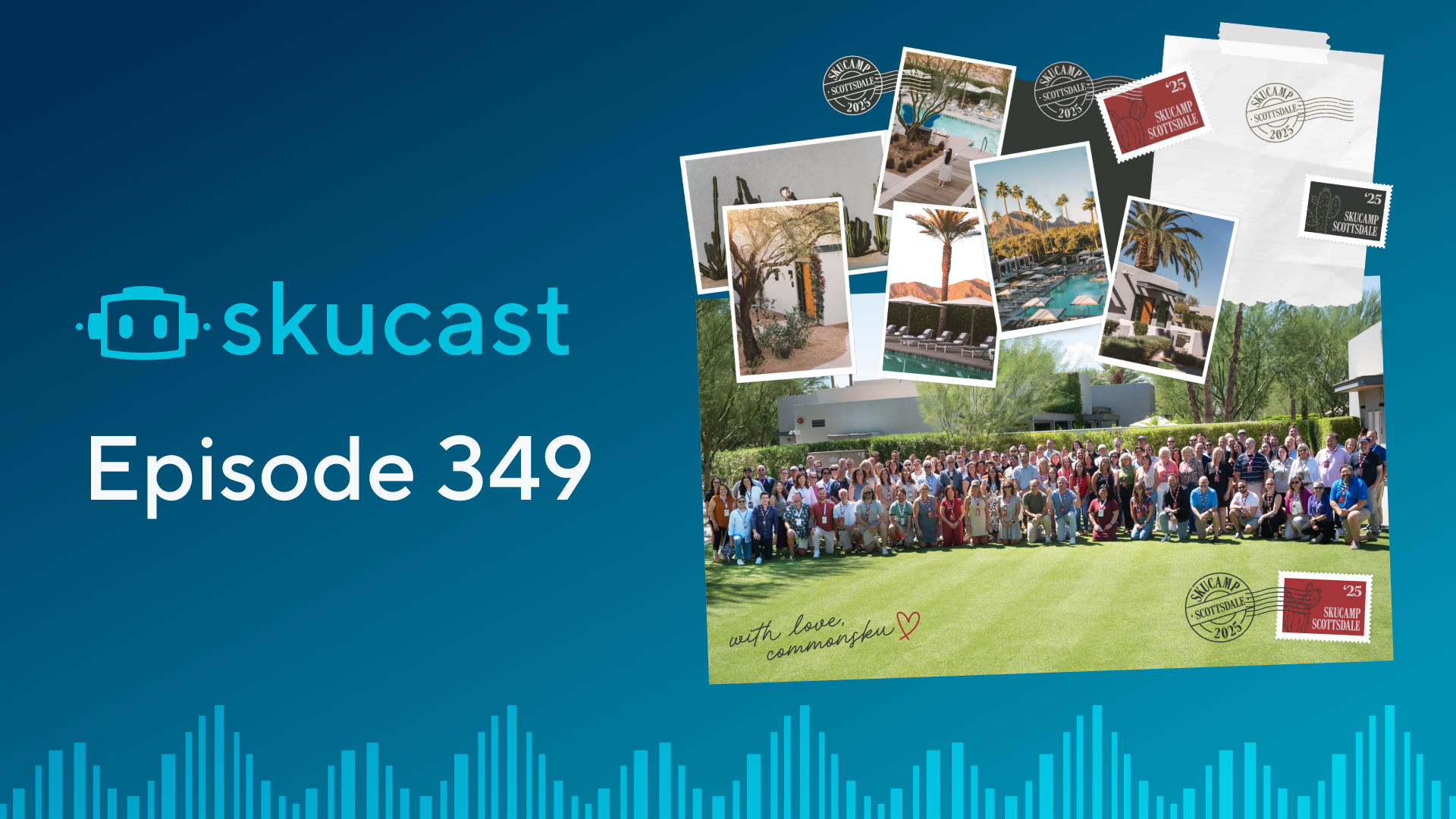
Episode 349: The Scottsdale Experience (Inside skucamp 2025)
No video selected
Select a video type in the sidebar.
We captured the moments from skucamp 2025 that had everyone taking notes—and if you've been wondering what industry leaders share when they're being completely honest, this is your backstage pass.
skucamp isn't your typical industry conference. No vendor halls. No speed networking. No safe corporate presentations. Instead, commonsku created something radical: a business bootcamp in the Sonoran Desert where industry leaders share what's really working, what's completely failing, and what's about to disrupt everything.
This year's Scottsdale gathering brought together CEOs who've grown family businesses from $6 million to $30 million, founders who implemented four-day work weeks that actually increased productivity, and supply chain activists who'll make you rethink every "ethically sourced" claim you've ever made. Dan Gingiss dismantled 20 years of customer service assumptions. Kyla Scanlon explained why your five-year plan is worthless. Daniel Stewart closed with analogies so memorable you'll actually use them Monday morning. Meghann Bezdikian revealed how moving a logo two inches doubles perceived value. John Henry decoded the DNA of impact players versus clock-watchers.
A Taste of What Went Down in Scottsdale
This episode isn't the full skucamp experience—that's impossible to replicate. But we captured the turning points, the mic-drop moments, and the insights that had attendees frantically scribbling in their notebooks.
Here's The Context: The Scottsdale sun was brutal outside, but inside the Andaz resort, industry titans were being brutally honest. Frank Mayers, Pierre Montaubin, and CJ Schmidt—three supplier CEOs controlling billions in industry volume went completely off-script, asking each other questions nobody prepped for. No talking points. Just truth about AI adoption, tariff preparation, and why print-on-demand isn't a trend but a transformation.
Shayna Cohen's segment captures her explaining how five letters—"E-T-D-B-W" —became a philosophy that quintupled revenue.
Daniel Cardozo's moment on stage wasn't comfortable for anyone. Hired off a picket line to run Ethix Merch, he challenged every assumption about ethical sourcing.
The glimpses of Joel Antymniuk explaining his four-day work week, Meghann Bezdikian demonstrating design thinking, and Daniel Stewart's unforgettable management analogies give you just enough to understand why attendees are already planning for skucamp 2026.
What Makes skucamp Different (And Why These Highlights Matter)
skucamp operates on radical transparency. Speakers share real numbers, actual failures, and strategies they're implementing right now. The breakout sessions force competitors to become collaborators. Morning swims create accountability partnerships. Dine-arounds produce joint ventures.
This highlights episode captures this energy—the vulnerability of leaders admitting mistakes, the excitement of discovering solutions, the relief of learning everyone faces similar challenges. You're not getting a conference recap. You're getting concentrated wisdom from people who've earned their insights through experience, not education.
The format breaks every rule: no hiding behind laptops, no sitting with your team, no escaping difficult conversations. What emerges is truth. Raw, actionable, profitable truth.
Your Preview of Industry Transformation
These highlights arrive at the perfect moment. While everyone's crafting 2026 strategies, you're getting intelligence from leaders who've already tested what works.
Each snippet we selected represents hours of deeper discussion, but even these highlights contain enough actionable intelligence to reshape your approach.
Press play and understand why skucamp tickets sell out!
Show Notes: Key Timestamps & Topics
[00:01:32] Dan Gingiss: Becoming "experience makers"
[00:03:05] Kyla Scanlon: Making decisions in chaos
[00:04:52] Shayna Cohen: ETDBW philosophy
[00:05:47] Daniel Cardozo: Ethical supply chain realities and industry accountability
[00:07:14] Joel Antymniuk: Four-day work week and making moves from your highs
[00:08:49] Supplier Panel: Unscripted questions about POD, M&A, and growth drivers
[00:11:16] Meghann Bezdikian: Fashion-first design hacks for promo
[00:13:34] Daniel Stewart: "Show up with the throw up" and "Don't be a Smurf"
🎙️ Read Full Episode Transcript
[00:00:00] Bobby: Hi friends. Bobby Lehew here, Chief Content Officer at commonsku. Today's episode is a little different. We're sharing highlights from our business bootcamp experience called skucamp, a gathering created to challenge, inspire, and equip forward-thinking leaders in promo. Now skucamp started from this passion of ours to elevate the industry and inspire leaders like you, and it's grown into this one-of-a-kind experience that brings together some of the brightest minds in the business.
[00:00:26] This year's lineup was loaded with insights and actionable tactics, all against the stunning backdrop of the Sonoran Desert in Scottsdale, Arizona. Today you'll hear a sampling of some of the moments from skucamp, from topics ranging from customer experience to making smart decisions in an uncertain economy, from growing your operations to navigating supply chains and tariffs, developing impact players, and leading beyond the grind.
[00:00:51] Today's episode is brought to you courtesy of us at commonsku. Over 900 distributors powering $1.8 billion in network volume rely on commonsku's connected workflow. Process more orders, connect your team, and dramatically grow your sales. To learn more, visit commonsku.com. Now here are the highlights from the skucamp stage in Scottsdale.
[00:01:12] First up, Dan Gingiss, international keynote speaker and author of the book "The Experience Maker." With 20 years in leadership at McDonald's, Discover, and Humana, Dan knows what separates remarkable customer experiences from ordinary ones. He shared his WISE framework, showing us how to be Witty, Immersive, Shareable, and Extraordinary.
[00:01:32] Dan Gingiss: We have to do something different to stand out, and today we're gonna talk about exactly what that is. In fact, today you all are going to walk out of here being what I call experience makers. Experience makers are people that make every business decision through the lens of their customer. They ask, "Is this good for our customer?"
[00:01:57] And if yes, they proceed. If no, we gotta come up with a different answer. And I promise you this: if you make every business decision through the lens of your customer, you will make better business decisions. And that's what experience makers know. Experience makers know that customer experience is the last true differentiator.
[00:02:20] We can't compete on price anymore, especially with tariffs and everything going on. Price is not how we're going to win. And it is tough to compete on products because, let's be honest, let's just call it what it is. A lot of people are selling a lot of the same products out there. And even if we can create a product that no one else is selling, chances are down the road, someone's gonna copy it.
[00:02:43] But the one thing that they can't copy is your experience. It's the one thing that is unique to you. And today, we're gonna learn how to turn that experience into your biggest competitive advantage.
[00:03:00] Bobby: Next, we heard from Kyla Scanlon, bestselling author of the book "In This Economy" and one of today's most trusted voices on making complex economics accessible.
[00:03:05] Kyla has not only been featured on the front page of the Wall Street Journal, she's also been on Jon Stewart's show and Ezra Klein's show, and she's making the normally difficult topic of the economy accessible to everyone. She broke down the uncertainty businesses are facing right now from AI disruption to trade policy changes, and gave us a framework for making decisions when the future feels unpredictable.
[00:03:27] Kyla Scanlon: So the uncertainty smoothie in this metaphor is AI disruption, geopolitical fragmentation, demographic shifts, and changing fiscal and monetary policy. So when you speak to most economists, these are the four main things that they're most worried about when we think about the long-term future for the economy.
[00:03:49] And so what do you do about all of this as business owners and people right now? The challenge isn't removing uncertainty, it's living with it. So I feel like oftentimes as people, as people who want the business to succeed, who want to do a good job, the goal is to remove every element of uncertainty, right?
[00:04:09] But that's not something that's very feasible right now. It's never really feasible. But right now, the goal is not to just get rid of it because things are going to be changing quite rapidly, just due to all the factors that I talked about earlier. And so the goal is: how do you live with this uncertainty?
[00:04:24] How do you make the right decisions? How do you make sure that you're navigating this world the best that you can?
[00:04:29] Bobby: Shayna Cohen transformed her family's promo business from $6 million to over $30 million in revenue in just four years as CEO of Team SCG. She shared the mindset shifts and strategic decisions that drove this remarkable growth,
[00:04:46] including why she makes decisions based on the company she wants to be, not the one she currently is.
[00:04:52] Shayna Cohen: My dad teaches me things every day and in 2020 he came and he said, "Shayna, I figured it out." I said, "What'd you figure out?" He goes, "We have to be ETDBW." Say that five times fast. All it means is we have to be Easy To Do Business With.
[00:05:12] When your clients interact with us, we have to be the easiest part of their day. If that means we have to go out of our way to do something that doesn't necessarily make sense for our business, but it makes sense for them, or take an extra step that we wouldn't typically have to take, that's what we were gonna do.
[00:05:28] Bobby: Daniel Cardozo, CEO of Ethix Merch, brought a challenging but necessary perspective to skucamp. As an activist CEO focused on ethically sourced and union-made merchandise, Daniel confronted the industry about the real conditions in our global supply chain and called for genuine accountability rather than compliance theater.
[00:05:47] Daniel Cardozo: It's quite clear to me that there's no invisible hand ensuring justice for garment workers. There's only our hands and workers' hands building our industry together. So as I wrap up, I want to invite you to participate in writing a new chapter in the story of promo—one rooted in integrity, accountability, community, and courage.
[00:06:11] A chapter where we don't wait for embarrassing PR fiascos to start making sure that workers in our industry are safe. A chapter where Robin's passport isn't locked up in the manager's office, a chapter without bribes and off-the-books subcontracts that hide the reality of being a low-wage worker in our industry.
[00:06:30] The chapter we write won't read like a fairytale on our corporate social responsibility landing pages. In fact, it will be messy and expensive and hard. But if we do this right and start genuinely grappling with the realities of global supply chains, there's a good chance that all the characters in our story, not just those on the top of the food chain, will be able to live happily ever after.
[00:06:55] Bobby: Joel Antymniuk, founder and CEO of Motif, shared his philosophy on sustainable growth and personal leadership. From implementing a four-day work week to his unique decision-making framework, Joel showed us how bold moves and authentic leadership can transform both business results and company culture.
[00:07:14] Joel Antymniuk: A big part of our jobs as leaders, founders, and CEOs is to see the big picture, step back and look in, even look away—look away at nothing.
[00:07:20] That's usually when my best ideas come to me is when I'm not focusing on finding good ideas. Don't just be busy. Be aware that the craving to be busy is neurological. It's that immediate gratification that feels amazing, and that was a big part of the transition from management to leadership. There's way less of that immediate gratification.
[00:07:39] There's no immediate fires. You have a manager taking care of the immediate fires. The quick dopamine kicks is what you're craving. Delay that stuff. Delay your gratification. It's worth it. And so to end off this presentation, I'd like to share a big aha moment I had: make moves from your highs. If the idea is consistent when you're at your best, act on it.
[00:08:03] That's where the bar moves up. Where impact and success live. Use your lows to test and challenge the idea as it's an important part of the process, but trust your highs. That early morning coffee brain is where the dreams are. That's where others do not have the courage to operate.
[00:08:20] Bobby: Our supplier panel brought together three industry giants: Frank Mayers of S&S Activewear, Pierre Montaubin of Koozie Group, and CJ Schmidt of HIT Promotional Products.
[00:08:31] They discussed navigating supply chain challenges, AI implementation, and the future of our industry. And we published an entire episode of this panel. But here's an important segment where the three leaders have a chance on stage to ask each other questions, completely unscripted, and it started with Frank Mayers asking this:
[00:08:49] Frank Mayers: What do you think the biggest driver of growth for our customers is over the next 24, 36 months?
[00:08:55] CJ Schmidt: That's a great question. If you skip to two years from now, I think POD—Print on Demand—is gonna be a larger portion of everybody's business in this room, no matter if you're a supplier or a distributor.
[00:09:09] Pierre Montaubin: What's the hardest part about merging major companies together?
[00:09:12] CJ Schmidt: Yeah, I think the system part of it. It's like, you wanna move really fast and it's easy to recreate what already existed at one of the two companies, but to stop and try and make something different that—so you have to make one plus one equal three, otherwise it's not worth doing an acquisition.
[00:09:28] And so the system, the way you're solving for customers' problems is what drives that magic from any acquisition. So just being disciplined and not being like, "All right, this is—I'm trying to get from here to there. I'm gonna go fast and straight at it." And sometimes you might realize you actually wanna be over there.
[00:09:44] Pierre Montaubin: Yeah, it's a great question. We need to look at risks and benefits, right? So every time we do this type of integrations is: are we gonna serve better the community or not? So I would not have had any problems staying into different systems if we didn't see a benefit. But on the flip side, bringing whatever is done on both sides to bring the best of both worlds.
[00:10:10] So the example, Imagen Brands—when we bought Imagen Brands in December 2020, it took us more than three years to integrate them because we wanted to take our time, but they had a very slick way of displaying orders that were due the same day or due the next day so that the operator on the floor will see immediately what they had to work on.
[00:10:32] We brought that to Koozie Group because this was a game changer, right? So every site director at Koozie Group was visiting Imagen Brands saying, "I want the same thing." So ideas are everywhere, and they spark from every interaction that we have with employees, with supervisors on the floor, and we need to be listening to be able to take those and bring them to a better, newer system.
[00:10:57] Bobby: Meghann Bezdikian, co-founder of Box Sourcing and Production, brought a fashion-first approach to promo with her background in fashion design and development at companies like Anthropologie. She showed us how to elevate ordinary products into extraordinary brand experiences through thoughtful design, a few important hacks, and creative positioning.
[00:11:16] Interviewer: We get a mug, we have a tote, and we are suddenly faced with this creative crisis, this mini crisis multiple times throughout the week of how do I add distinction to this, and you talk about this a lot in your branding. Do you have some creative hacks that you use for that?
[00:11:32] Meghann Bezdikian: Yes. Oh yeah. Yeah. So the most simple one is say you take just a regular notebook.
[00:11:35] Everybody knows Moleskine, they have the really affordable one. You know, just turning the client's logo, putting in the bottom left corner. You wouldn't believe how just a little hack like that makes it feel so elevated. Also, you know, when you saw that other presentation with the different hats having like a contrast trim that matches their logo.
[00:11:54] Just, you know, instead of a basic tote, do one with a little contrast strap. We all love Numo. They have specialty—you know, you can pick your trims and all that. And then we also like to play with the logo. So if it's a lockup of a logo, you take the elements and break 'em apart. Like don't be afraid to not alter their logo 'cause you don't wanna do that, but just to get creative with it.
[00:12:15] Bobby: John Henry started JH Specialty in college and he grew it into a 50-plus person company focused on culture and creative solutions. His presentation on building impact players showed us how to move from managing tasks to empowering people, using frameworks like EOS to create accountability and measurable growth.
[00:12:34] John Henry: So what is an impact player? Liz Wiseman defines it as someone who delivers extraordinary value by doing the job that needs to be done, rather than just their assigned role, and who makes the entire team better through their mindset and actions. So, I'll talk about this a little bit later, but Liz Wiseman wrote a book called "Impact Players," and this really was something that got things moving.
[00:12:57] The alternative is a high contributor, right? They wanted to know exactly what you want 'em to do, and when it's five o'clock, they're ready to go. And we all need those inside of our organization. But the more impact players that you can have, at least for us, has really proven to be successful.
[00:13:12] Bobby: And we wrapped our lineup of speakers with Daniel Stewart. Now Daniel Stewart is president of creative agency Wier/Stewart and sister company Show Pony. He's a nationally recognized designer turned agency leader. Daniel shared his philosophy of "show up with the throw up" and gave us practical tools for building creative teams, managing clients, and solving problems with both humor and accountability.
[00:13:34] Daniel Stewart: A couple of stories, and I'll start out with "show up with the throw up." When I was a kid, and let's say like Mortal Kombat II came out on Sega Genesis, and I had just gotten it that weekend, and I didn't want to go to school on Monday because I was obsessed with playing the game or whatever. I'd wake up for school on Monday and I'd be like, "Oh mom, I can't go to school today.
[00:13:54] Like, I'm sick. I threw up." And my mom would be like, "Oh, you threw up? Show it to me."
[00:14:04] And I was like, "Ah, I'm sorry. I've, I've flushed the toilet. It is, it is gone. There is no throw up." And she's like, "Oh, really? Huh. Interesting. No evidence. Get your ass to school."
[00:14:18] So "don't be a Smurf" is something that I say a lot. And this is about problem solving. If anybody watched the Smurfs, Gargamel would always catch the Smurfs.
[00:14:24] Always Clumsy Smurf's fault, by the way. Always. And Gargamel would put the Smurfs in a cage like this, and the bars on the cage are like this far apart, and they're like, "Oh no, I got caught. I can't get out." Walk out. Walk out of the cage. You can literally walk between the bars. So if you have a teammate that's doing something, "Ah, we can't process this order for this reason," or, "Yeah, we're not gonna be able to get that done by this day."
[00:14:52] You can be like, "Are you Smurfing right now? Are you Smurfing?" Like, you know, and that's just a nice—is it a nice thing to say? It's just an easy way to say you need to figure out a better solution to what is going on. Don't be a Smurf.
[00:15:08] Bobby: Those are the highlights from skucamp Scottsdale. But skucamp shows us that success in our industry isn't just about products and pricing and positioning.
[00:15:17] It's about experience, leadership, accountability, and having the courage to do things differently. Whether you're implementing a sparkler moment for customer experience, making decisions based on the future goals of who you want to be, or simply refusing to be a Smurf when solving problems, the path forward requires bold action.
[00:15:35] And a big thanks to the community.
[00:15:38] You are what makes skucamp special. From the breakout groups to the dine-arounds, you come with an open book, an open heart, and an open mind, not only to learn from each other, but share your best experiences, and that is why we love skucamp. Thanks for listening to this special edition from skucamp, and tune in for our next episode, or we'll see you at our next event.
[00:16:01] We have exciting news coming for 2026.
