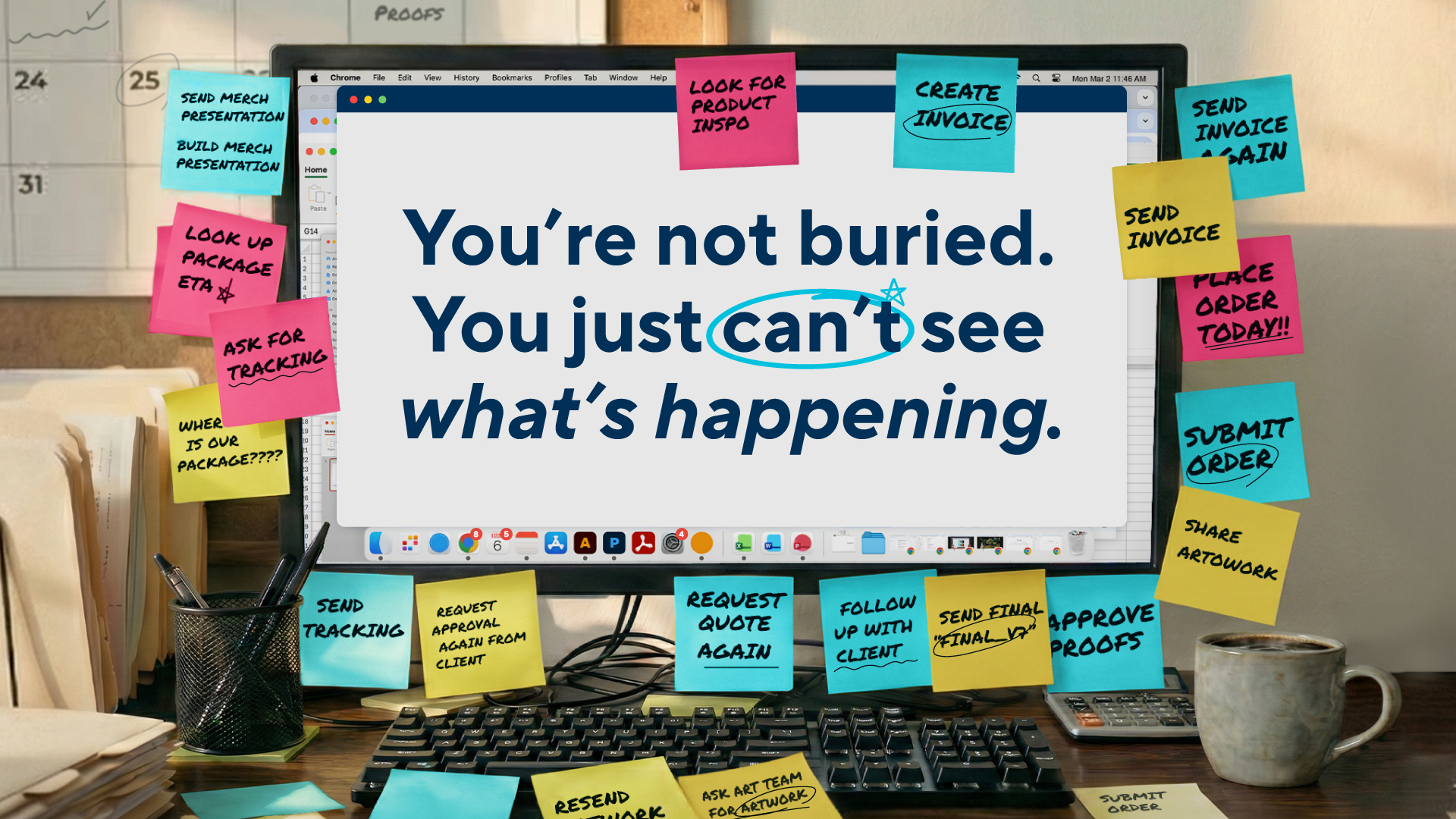
There's a question most promo distributors can't answer quickly: right now, across every merch project your team is running, what needs attention today?
Not tomorrow. Not after you dig through your inbox. Right now.
If you paused, that pause is the problem. The problem isn't you. It's that the information you need to run your business lives in too many places to see the full picture.
PPAI research from earlier this year found that nearly a third of distributors saw their margins decline, even as the industry posted record revenue. When you're selling more but making less, the time your team spends chasing information instead of doing the work isn't just frustrating. It's expensive.
The result isn't dramatic. It's quiet. It shows up as five familiar fire drills that eat your day before you ever get to the work that actually grows your business:
1. Your inbox decides your day before you do
You open your laptop with a plan. Follow up on that proposal. Prep for the afternoon client call. Maybe even prospect. Remember prospecting? LOL.
Then the emails load. Forty-something messages. Half are internal: someone asking about an order status, a colleague hunting for a file, a supplier responding to something you forgot you sent. The other half are clients and suppliers waiting on answers buried in someone else's thread.
By 10 AM, you're deep in other people's priorities. Your plan is gone. Tomorrow, the same thing happens.
This is what it looks like when no one on the team has a shared view of what's in progress and what needs action. Every update that should be visible becomes an email instead. Multiply that by every merch project your team is running, and your inbox becomes your operating system. A really bad one.
2. "Where's my order?" is a fifteen-minute scavenger hunt
A client sends a message: "Hey, any update on the order?"
Simple question. Should take ten seconds. Instead, you're checking your inbox for the supplier's last email, opening a spreadsheet for the PO number, maybe texting a colleague who might have the shipping details saved on their desktop somewhere.
Fifteen minutes later, you reply to the client with a confident answer. But behind that reply was a scavenger hunt across three or four disconnected systems. The client has no idea how hard it was. Your team knows, because they do it ten times a day.
The information exists. It's just scattered. And every time someone asks a question that should be easy, the cost isn't just time. It's the erosion of both client and team confidence that you're on top of things.
3. You're re-entering the same data into different systems, and every re-entry is a risk
And maybe you're not starting from scratch. Maybe you've got a CRM, an order management tool, a shared drive, an accounting system, a supplier portal, a proofing platform, a separate invoicing system. You don't have a paper-vs-software problem. You have a fragmentation problem. For some distributors, that fragmentation has grown into a patchwork of ten or more tools, each solving one problem while creating three more handoff points. None of them talking to each other. So your team becomes the integration layer, re-keying the same data from one system to the next and hoping nothing gets lost in translation.
Every re-entry is a fresh opportunity for a wrong digit, a mismatched address, a shipping error that becomes this afternoon's fire drill. The more disconnected your systems, the more you bridge the gaps by hand. And the more mistakes you create.
4. When someone's out, their clients might as well not exist
Your colleague takes a sick day. Or they're traveling for a show. Or, the scenario nobody wants to think about, they leave.
Suddenly, everything they were working on goes dark. Their merch projects, their client promises, their supplier conversations. All of it lived in their inbox, their browser tabs, and their head. There's no shared view of what's in progress, what's been promised, or what's due this week.
So the client calls the main line and gets someone starting from zero. Or they wait. Or they call again, a little less patient this time.
This isn't about one person dropping the ball. It's about work being visible only to the person doing it. When the only way to know the status of a merch project is to ask the person who owns it, you don't have a workflow. You have a collection of workarounds held together by memory.
5. The decorator gets the wrong file, and nobody's sure whose fault it is
The art file exists. Somewhere. The client emailed revisions last Tuesday. Your colleague downloaded them, probably. There's a version on the shared drive, but is it the approved one? Or the one before the logo change?
The decorator runs the job with the wrong version. Or an old file. Or nothing at all, because nobody could confidently point to the approved artwork. Now you're re-running the job, absorbing the cost, and apologizing to the client for something that should never have happened.
In an industry where 30% of distributors saw their margins decline last year, eating the cost of a re-run isn't just annoying. It's the kind of quiet loss that adds up fast when you can't see where the leaks are.
This particular fire drill stings because it isn't caused by carelessness. Everyone did their part. The breakdown happened in the space between people: where a file was saved, which version was final, who had the latest approval. When that space has no shared system of record, "final_final_v7" stops being a joke.
The Pattern Underneath the Fire Drills
Read those five scenarios again and they all trace back to the same root: nobody can see the full picture at any given moment.
Not the full picture of a merch project. Not the full picture of what the team is working on. Not the full picture of what a client has been told or what a supplier has confirmed.
The gap between the information that exists and the ability to see it when you need it turns routine work into messy work. It makes every simple question feel harder than it should be. And it's why your team keeps putting out fires instead of doing the work that grows the business.
These aren't signs that you're bad at your job. They're signs that the way work moves through your business has outgrown the tools you're using to manage it.
You already know that. You just haven't had the time to fix it, because you've been too busy putting out fires.
Still adding up the cost? The High Cost of Busy covers three more ways your workflow is costing you sales.
 For Owners
 For Sales
 For Production
 For Finance
 Presentations
 Shops
Shops
 Product Mockups
 Client Portals
 Product Search
 CRM
CRM
 Decorator Matrix
 Suppliers
 Navigation & Dashboards
 Production Management
 Reports & Analytics
 commonsku Payments
 Essentials
 Advanced
 Enterprise
 Customer Stories
 Events
 Blog
Blog
 eBooks
 skucast (Podcast)
 Ask skucast
 Webinars
 ROI Calculator
 FAQ
FAQ