
 For Owners
 For Sales
 For Production
 For Finance
 Presentations
 Shops
Shops
 Product Mockups
 Client Portals
 Product Search
 CRM
CRM
 Decorator Matrix
 Suppliers
 Navigation & Dashboards
 Production Management
 Reports & Analytics
 commonsku Payments
 Essentials
 Advanced
 Enterprise
 Customer Stories
 Events
 Blog
Blog
 eBooks
 skucast (Podcast)
 Ask skucast
 Webinars
 ROI Calculator
 FAQ
FAQ
SECTIONS
RELATED RESOURCES

What Honduras Taught Us About a T-Shirt
You've probably held a thousand t-shirts. Pulled them from boxes, checked the colors, handed them off to clients. You know the weight, the hand feel, the difference between a 5.3 oz and a 6.1 oz. You know tees by heart.
In this industry, a t-shirt becomes a SKU pretty fast. The project moves from a presentation to a sales order and into production in the commonsku platform swiftly. And yet behind that efficiency, there's an entire supply chain impact with human stories along the way that we don't see. Not because anyone chose to ignore it — but because you’re trying to hit a deadline and moving fast, which creates a little distance from our product and the people who make it. But what we're trying to do is bring back the human impact to this proficiency story.
So when the chance came to close that distance, we took it.
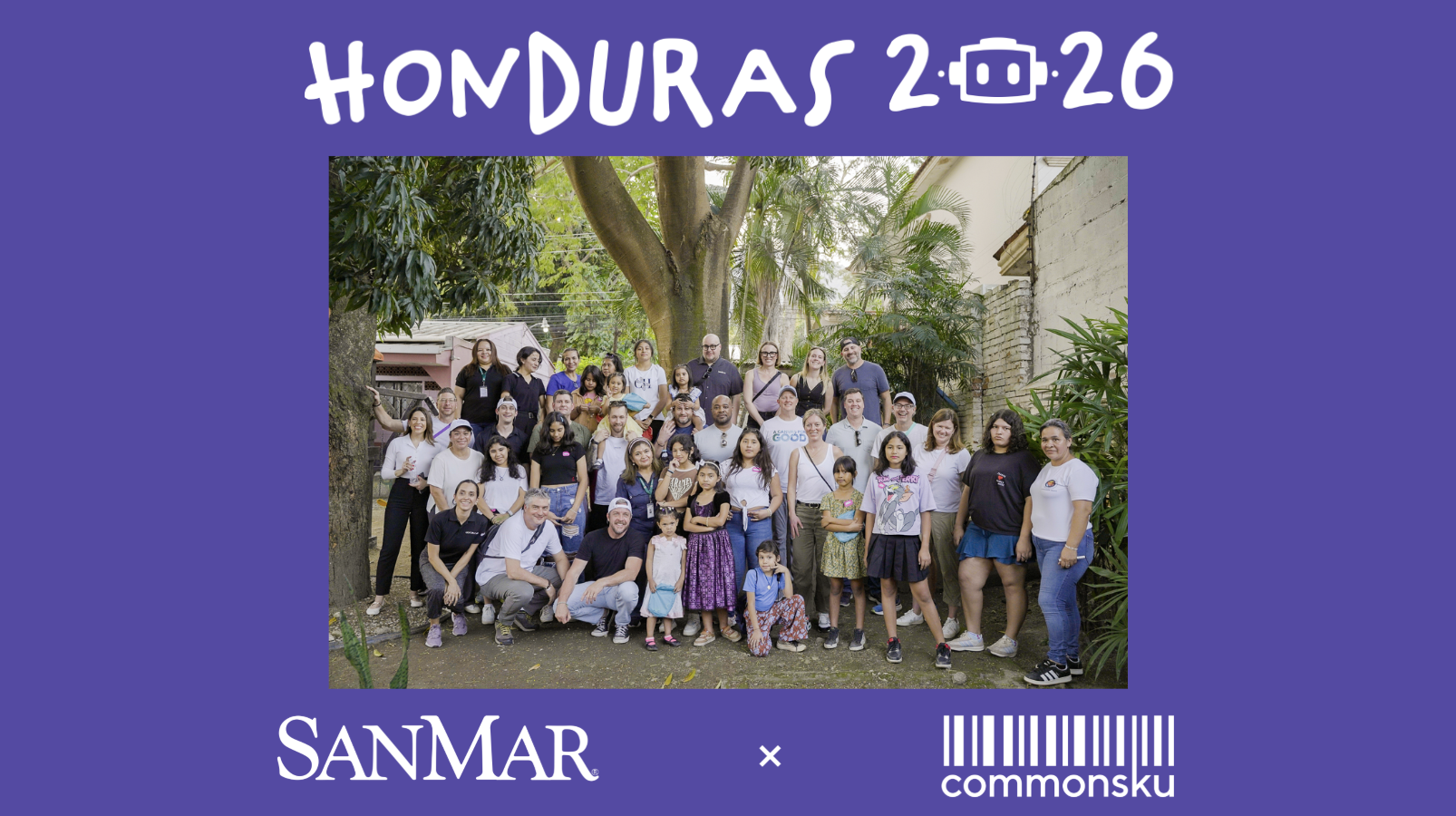
In early March, a group of us from commonsku — Mark Graham, David Shultz, Catherine Graham, and Aaron Kucherawy — traveled to San Pedro Sula, Honduras with distributor customers Tom Rector (Thumbprint), Matt Fischer (Probitas Promotions), Lee Fine (Juice Marketing), Richard Hill (The Promotions Dept.), Michael Harper (Summit Group), Stephen Holden (Holden), Brett Boake (Score Promotions), Fred Daniels (STS Brand), Todd Mawyer (TK Promotions Inc.), Harrison Barker (Barker Specialty Company), Carl Wilking (Imprint Engine), and Kirby Hasseman (Hasseman Marketing & Communications), and we were hosted by the team from SanMar. The plan was to visit SanMar's textile operations and their manufacturing partner Elcatex. To see, firsthand, how a t-shirt goes from raw material to finished garment.
Dirt To Shirt
The phrase "dirt to shirt" gets tossed around, but until you're standing on the factory floor, it's just a phrase. In Honduras, it became real.
The journey starts with cotton — raw, unprocessed, straight from the fields — and plastic chips, both virgin and recycled. From there, it moves through a sequence of steps that most people in this industry never see: spinning yarn, knitting fabric, dyeing it in massive industrial vats, cutting panels with precision machinery, and finally, sewing — skilled workers assembling garments piece by piece.
Here's the thing nobody talks about: 65% of the cost of making that shirt is some seriously advanced tech. It’s so advanced, we can’t even reveal some of the processes because they are proprietary. But the yarn-making, the fabric-weaving — almost entirely done by machines. The sewing is the human-intensive part, but everything before it is far more high-tech than anyone in this industry realizes. The supplier has always been "the guy with a warehouse full of blank stuff." Turns out, that's never been the full story. Not even close.
And Honduras itself defied every assumption. Most of us expected something modest. What we walked into was the opposite — facilities and technology that would hold up against anything you'd find in a major North American city. One plant runs seven days a week and ships millions of units a year. This isn't some scrappy operation. It's a global hub of innovation in the apparel space .
The group moved through UTEXA, Parkdale Spun Yarns, San Juan Textiles, and the Genesis and Francis sewing plants. At each stop, roughly the same thing happened. Someone who's been selling t-shirts for twenty years would walk up to a production line, go quiet for a second, and then say some version of the same thing: I had no idea.
The Other Side Of The Supply Chain
Honduras showed us something else entirely.
SanMar and Elcatex have invested deeply in the community where these garments are made. Not as a side project — a deep commitment. Single-family homes built for employees through a housing initiative. A school. Girls' and boys' orphanages. None of this shows up in a product catalog.
The investment in education runs deepest. Without it, the cycle is familiar: kids don't finish school, opportunity narrows, inequality widens. With it, there's a path: a stable job, a livable wage, a home to own. SanMar and Elcatex aren't just funding classrooms. They're building reasons for people to stay and invest in their own community rather than leave it behind.
Our group spent time at each site. At the Mhotivo school, distributors walked through classrooms and met students. At the orphanages, they sat on the floor and did crafts with the kids, played soccer, shared meals together. The kind of moments where the professional context falls away and you're just a person, sitting across from a child, figuring out how to fold a piece of paper into something that makes them laugh.
The kids were joyful. Energetic. They taught a few of our group some things about soccer that won't be forgotten anytime soon. And the adults — people who spend their days running businesses — got very quiet on the bus ride back.
You can know something for years without it meaning anything. That's not a character flaw. It's just how speed and distance works. Our trip to Honduras closed that distance.
The Part That Followed Us Home
The group that flew to Honduras already knew each other — or at least knew of each other. This is a collegial industry. People run into each other at events, share a drink at skucon, trade notes in the skummunity. The warmth is already there.
But something happens when you layer enough new experiences on top of familiar relationships. A new country. An orphanage visit that catches you off guard. Watching cotton become a shirt. Good food, bad soccer, jokes that only land because you've all been in the same strange day together. It builds into something a conference floor never could.
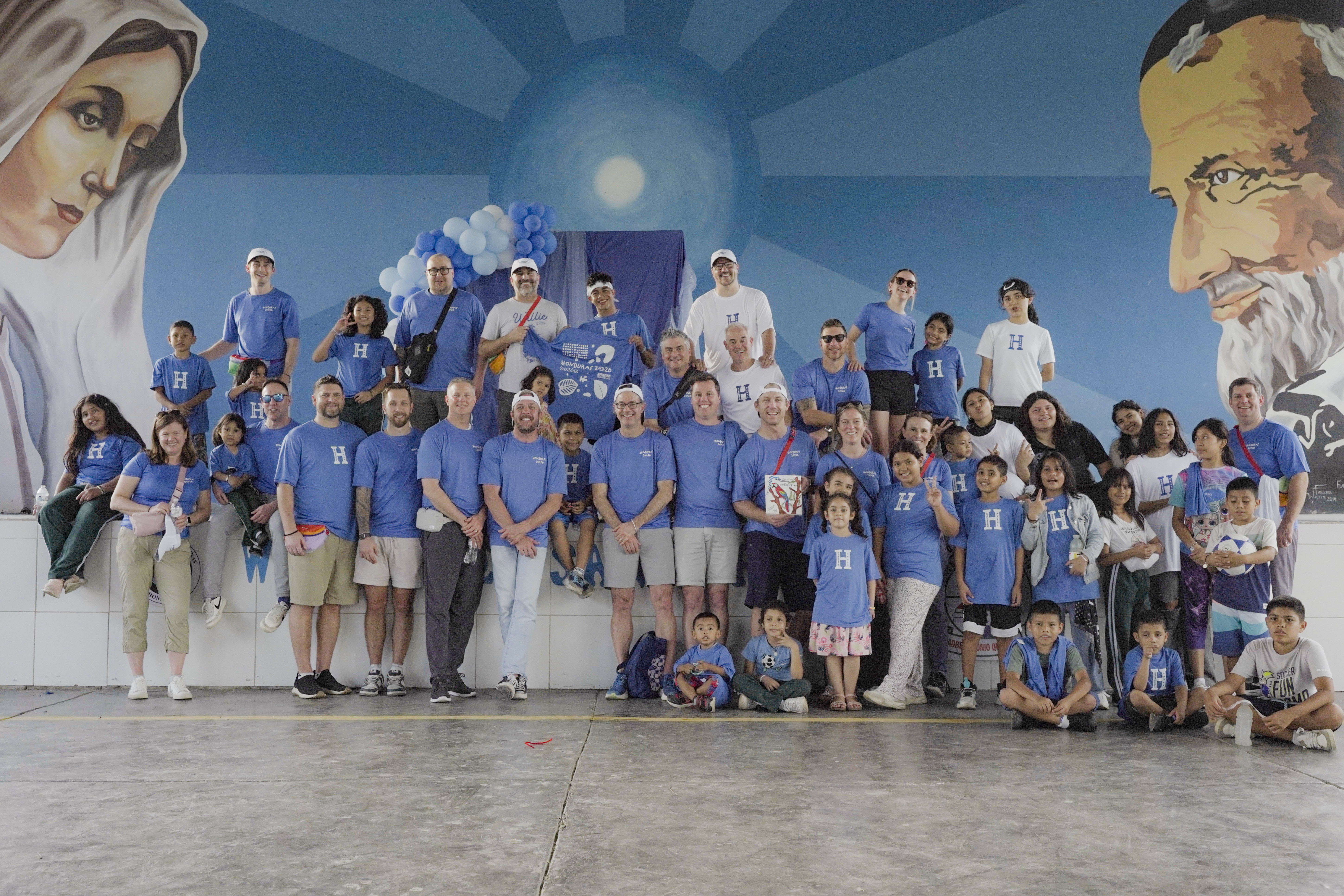
By the final dinner, the room felt different than it did on Day One. Not because anyone gave a speech about it. Just because you can't share four days like that and come home the same. These distributors will go back to their businesses. They'll sell the same products. But they can talk about those products differently now — where they come from, who makes them, what it takes. That changes the conversation with every client they sit across from. And it changes the conversation with their teams too.
That's what the skummunity keeps becoming — not just a network, but a reason for the best people in this industry to go deeper together. We started as a software company. Somewhere along the way, it turned into something bigger. Standing in Honduras with twelve distributors and the team from SanMar, watching all of it come together, the thought was hard to shake: it all started with a t-shirt.
So Now What?
The products don't change. The rush orders still come in. The reorders still go out. But somewhere in Honduras, someone is sewing a seam with a precision skill that takes years to build. A kid is at a school that exists because a company decided that community was part of the product.
And you are part of that story too. Every time you sell a t-shirt, every time you place an order. Honduras made that visible. You can't make it invisible again.
A special thank you to Jeremy Lott, Jesús Canahuati, Molly LaBonte, Fred Hickman, Patrick Noonan, Renton Leversedge, and the entire SanMar and Elcatex teams for their hospitality — and for showing us what's possible when an industry decides to go deeper.
By Mark Graham, Catherine Graham, David Shultz, and Aaron Kucherawy
RELATED RESOURCES