
 For Owners
 For Sales
 For Production
 For Finance
 Presentations
 Shops
Shops
 Product Mockups
 Client Portals
 Product Search
 CRM
CRM
 Decorator Matrix
 Suppliers
 Navigation & Dashboards
 Production Management
 Reports & Analytics
 commonsku Payments
 Essentials
 Advanced
 Enterprise
 Customer Stories
 Events
 Blog
Blog
 eBooks
 skucast (Podcast)
 Ask skucast
 Webinars
 ROI Calculator
 FAQ
FAQ

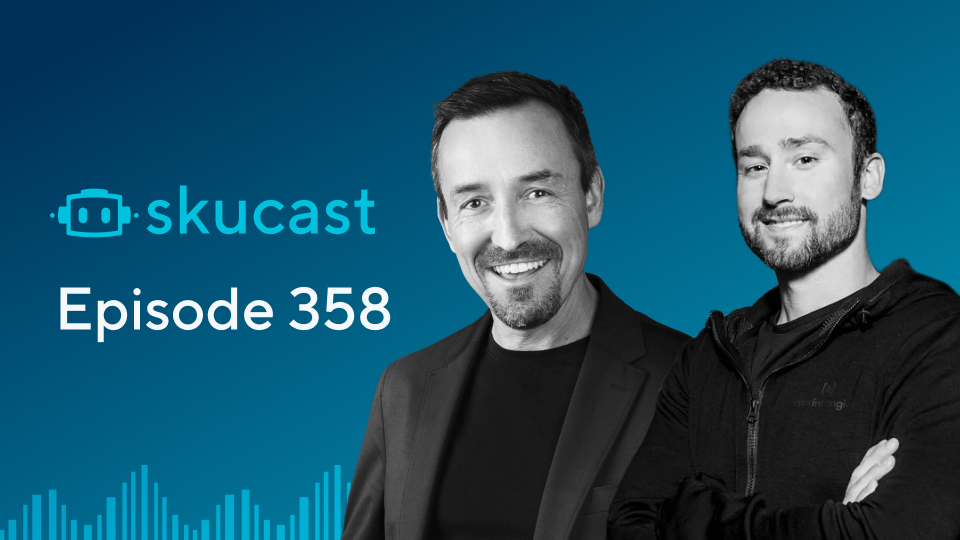
Episode 358: Imprint Engine's Global Playbook for Promo
No video selected
Select a video type in the sidebar.
Two folding chairs. A Google spreadsheet. A closet-sized living room in Uptown Minneapolis.
That's where Caleb Gilbertson and Travis Veit sat back-to-back in 2012 and started building what would become one of the most ambitious distributor stories in promotional products. Thirteen years and $150 million in lifetime revenue later, Imprint Engine operates across four continents with 100+ employees and they're just getting started.
On today's show, recorded live at PPAI Expo at the Mandalay Bay in Las Vegas, we sit down with CEO Caleb Gilbertson and newly appointed Global Chief Revenue Officer Colin Loughran. Their conversation maps the blueprint for distributors who want to think bigger than their zip code—covering everything from why the industry's biggest companies still can't deliver a unified global brand experience, to how AI champions embedded in every department are transforming workflows, to the uncomfortable prediction that supplier-distributor walls are already crumbling.
Caleb won commonsku's Distributor Entrepreneur of the Year award. Colin, a 20-year industry veteran and one of PPAI's Coolest People In Promo, spent a decade in leadership at Gold Star before being recruited from Dublin to lead Imprint Engine's worldwide revenue strategy. He had zero interest in returning to the distributor side until he saw what Imprint Engine was building.
One System, Four Continents
Most global distributors aren't actually global—they're networks of regional partners stitched together. Caleb's observed this even among the industry's top five. Enterprise clients notice the seams.
Imprint Engine's edge is integration: one team, one platform, one consistent experience whether the order ships from Minnesota or Dublin. Their global expansion wasn't driven by ambition, it was driven by clients like Uber who needed them to show up everywhere.
Colin frames the addressable market: $26 billion in North America, $14 billion in Europe. For companies that think connected, the upside is enormous.
Delegate or Die
Caleb credits the EOS delegate-and-elevate framework for every growth phase at Imprint Engine. The exercise is simple: list what you love, what you like, what you tolerate, and what you hate. Then systematically remove the bottom two categories from your plate.
Over a decade, he's shed marketing, operations, and now revenue leadership. Each handoff felt risky. Each one unlocked the next stage of growth. His advice to distributors stuck at a plateau: the thing you're white-knuckling is probably the thing you need to let go of first.
AI With a Calculator, Not a Crystal Ball
Instead of company-wide AI experimentation, Imprint Engine placed a champion in every department with a specific mandate: map workflows, identify automation opportunities, calculate ROI. The question isn't "can AI do this?" it's "what's the three-year return if we invest a million dollars automating this function?"
In this episode, we also discuss:
- Why the supplier-distributor line is dissolving and Caleb's Swag 2035 prediction for what replaces it
- Imprint Engine's acquisition strategy: what they look for in distributor targets
- Building culture across four time zones and why Caleb spent most of 2025 living in Dublin
- The growth team model that separates new logo acquisition from account expansion and client success
- How commonsku powered Imprint Engine's growth from $3M to $30M+ and became the backbone for team-based selling and weekly KPIs
→ Wish to Learn more, Book a demo with our team
Show Notes: Key Timestamps & Topics
[00:02:06] $50M to $150M+ in lifetime revenue
[00:08:01] The strategic leadership split: CRO vs. CEO roles
[00:13:47] Delegate and elevate
[00:17:36] AI champions in every department
[00:25:42] commonsku's role in scaling from $3M to $30M+
[00:29:07] Culture as a living organism
[00:39:10] Crumbling supplier-distributor walls
[00:47:01] Why branded merch gets more powerful
This post was lovingly co-crafted by Claude (AI) and Ritz, with final editorial oversight by Bobby.
🎙️ Read Full Episode Transcript
[00:00:00] Music Intro
[00:00:06] Bobby: They started with two folding chairs, a Google spreadsheet, and now over $150 million later in lifetime revenue. They've built a unified brand experience across four continents. On today's show, we're exploring how Imprint Engine is rewriting the rules of what a modern distributor looks like. Welcome to the skucast, the podcast for innovators and maverick thinkers in the promotional product space.
[00:00:28] Bobby: My name is Bobby Lehew. I'm glad you're here. Caleb Gilbertson co-founded Imprint Engine in 2012 with Travis Veit out of a tiny apartment in Minneapolis. Today, Caleb's CEO of a tech forward global distributor with offices in Dublin, India, and soon Australia. Colin Loughran is Imprint Engine's newly appointed global Chief Revenue Officer, bringing over two decades of experience across the distributor, supplier, and consulting sides of the industry now leading revenue strategy from Dublin.
[00:00:56] Bobby: We connected with Caleb and Colin at PPAI's Expo in January and recorded this in a suite at the Mandalay Bay. We talk about their bold global expansion strategy and why most distributors are getting global wrong, how they're deploying AI across the organization from department champions to workflow automation and where AI is not quite ready yet.
[00:01:16] Bobby: Also, we talk about building leadership culture, and a team-based selling model as you scale from startup to enterprise. Today's episode is brought to you, courtesy of us at commonsku. Over 900 distributors powering 1.8 billion in network volume rely on commonsku's connected workflow. Process more orders, connect your team and dramatically grow your sales. To learn how, visit commonsku.com. Now here's my chat from the Mandalay Bay in Las Vegas with Caleb and Colin.
[00:01:44] Bobby: Colin and Caleb, welcome.
[00:01:46] Caleb: Hey, thanks for having us.
[00:01:46] Bobby: Thank you. This is awesome to have you guys here. Appreciate it. In Vegas and Vegas. It is beautiful view behind us. Gorgeous light. It's a beautiful day and I can't believe I get to kick off my week talking to you guys. What an exciting time.
[00:01:59] Caleb: Likewise.
[00:01:59] Bobby: We have so much to unpack. We're gonna start Caleb with you 'cause you were on the skucast in April, 2022, as we know.
[00:02:06] Caleb: Yep.
[00:02:06] Bobby: And 50 million in revenue. What's the biggest change in the last three years at Imprint Engine?
[00:02:12] Caleb: Oof. There's been a lot of change. We've grown. I think we're probably north of 150 million in lifetime revenue now. Our team's twice the size it was, I think when we talked last time.
[00:02:21] Bobby: Yeah.
[00:02:22] Caleb: Our Dublin team has grown significantly. I think we were kind of just starting to launch the Dublin office when we talked last time, and now we're probably close to getting to 20 people and it's now getting close to 30% of our revenue. It's been a lot, and that was kind of right after COVID too. We were still trying to figure out where the world was gonna go, so I feel like the industry's normalized a lot more than it was at that time and we've grown our leadership team a significant amount as well. Like, yeah, Colin joining recently has been huge. Mike Schwandt, you've probably seen our content evolve a ton in the last couple of years. That's the...
[00:02:52] Colin: Yeah.
[00:02:53] Bobby: Pretty cool. The videos have been amazing.
[00:02:53] Caleb: Yeah. Yeah. That's a product of his genius, so yeah. It feels like we're a different company than we were.
[00:02:58] Bobby: Yeah. I covered this in my intro, kind of an overview of it, but let's hear from you the scope of Imprint Engine now locations. We have Dublin, we're about to get into this part of the conversation with Dublin. You're also thinking of growing in other markets. What's the footprint look like?
[00:03:11] Caleb: Yeah, so right now, like global headquarters, Minneapolis for North America, Dublin is our EMEA headquarters. And then we in the last couple years launched India. So we're using India as our hub for APAC. But then now...
[00:03:25] Bobby: Explain APAC.
[00:03:26] Caleb: APAC, so Australia, Asia Pacific. Okay. So India's been great. It's been a very interesting market. We went there because it's a very tough market. We like to solve hard problems, so we picked probably one of the hardest, it was definitely a challenge to get set up, but we've been finding a lot of success there, growing our customer base there. It's been very educational, um, but also exciting. Um, and it's also a very fascinating market. People are unbelievable.
[00:03:50] Bobby: Yeah.
[00:03:50] Caleb: And then Australia is next, so we're launching Australia this quarter, and that's kind of the next map on the...
[00:03:57] Bobby: Yeah. Is India more both for clients and sourcing, and then is Australia more for revenue growth or do you not even distinguish between the two?
[00:04:06] Caleb: Both for sure. We went into India primarily for sales and revenue and to support our customers, but that did require us to set up in the India supply chain, which is a lot less mature than it is in the US unless you're doing large scale manufacturing. So there isn't a SI or a Sage in India. It's a lot of small mom and pops and there are big textile manufacturers there, but there's not that, hey, I need a hundred, you know, mugs tomorrow. Like that doesn't really exist. So we did have to work on supply chain set up there. And then Australia's a little bit more of a mature market, I think. At least at this point, we think it'll be a little bit easier to enter. It's much more strategic. We really have always followed customer demand, so that's why we're in Europe.
[00:04:50] Bobby: I see.
[00:04:50] Caleb: Yeah. And that's why we went to India, right? We look at our customers and where they're located and where is their opportunity to support them better. And Australia is that next move. Um, and we'll see where we go from there.
[00:05:01] Bobby: So speaking of expanding, we meet Colin from Dublin, and Colin and I know each other. We met in Vienna.
[00:05:05] Colin: That's right.
[00:05:05] Bobby: Last year. So for folks that are listening and watching, we also have a mutual mentor, Rod Brown. Many people who are listening and watching also know Rod. But for this connection to happen, it's pretty amazing because you have this grow. Were you doing fulfillment primarily in Dublin? Is that, was that the core?
[00:05:20] Caleb: Yep, that was that.
[00:05:21] Bobby: Okay.
[00:05:21] Caleb: That's what we started to do there back in like 2018 ish.
[00:05:25] Bobby: Okay.
[00:05:25] Caleb: So yeah, we started just doing fulfillment and then we slowly took on more risk and started to build our team up there. And that was around when we talked last time in 2022, I think April, 2022 when we launched like our official team.
[00:05:37] Bobby: Okay. And Colin, you have had both experience working with distributors and suppliers. You were a supplier for some time, and then of course you've been leading GXN global network of professionals?
[00:05:50] Colin: Well, just the correction, I'm not leading the GXN. Michael Freter leads the GXN, which is I think one of the best networks.
[00:05:56] Bobby: Yeah.
[00:05:57] Colin: But you were involved?
[00:05:57] Bobby: I'm involved, yes. I'm a brand ambassador for the GXN.
[00:06:00] Bobby: Okay. That's where I got it.
[00:06:01] Colin: Yes, exactly.
[00:06:02] Bobby: So this is a switch for you. You were, you were like, I'm good in the consulting lane, I want to do that. And then what appealed to you about Imprint Engine?
[00:06:10] Colin: Yeah. Well, I started off actually in the distributor side, but if you even go back before that, I was a buyer of promotional products and so I went to the distributor side 10 years, and then I went to Gold Star for 10 years. Then I was consulting and I didn't really just go decide to go back to be a distributor. I was very attracted by Imprint Engine.
[00:06:31] Bobby: Yeah.
[00:06:31] Colin: That's the reason why I moved back to the distributor side, and again, it's only been six weeks for me. I joined the team, but whenever I, you know, I was introduced to Caleb by Jeff Solomon and so...
[00:06:42] Bobby: Yeah.
[00:06:42] Colin: Well, I looked at Imprint Engine. I was surprised that I didn't know them before number one, but number two, and you know this, Imprint Engine is not a traditional distributor, right? It's a very modern kind of tech forward global platform, bringing together technology, logistics, unbelievable creativity, and you know, this real true global service.
[00:07:07] Colin: So I hadn't seen anything like that in the industry. I got super attracted to Imprint Engine. I got genuinely excited by the project, and I felt like my previous experience could help me to help this team to achieve their goals.
[00:07:21] Bobby: Yeah, yeah. So you were a distributor supplier. You had significant experience in both, but you weren't planning on getting back in the distributor business until you saw what...
[00:07:30] Colin: I had no interest.
[00:07:30] Bobby: Inspired to do.
[00:07:31] Colin: I was inspired, absolutely, 100%. I was not planning to do this at all, and when I saw the company and I saw also Caleb, like his vision is very exciting. He's just got a really unique vision for the future of our industry, and I really believed in it, and so that's the reason why I moved to the distributor side.
[00:07:50] Bobby: Yeah.
[00:07:51] Colin: Again.
[00:07:51] Bobby: Tell us a little bit about this move to deciding we need a Chief Revenue Officer because this is a global Chief Revenue Officer that's unique.
[00:08:01] Caleb: Yeah. I mean, it's very intentional to bring in this position at the global level one, we've been so US centric, we started in the US large portion of our revenues in the US. We've got great revenue leaders regionally and I had been managing them, which is...
[00:08:18] Bobby: Yeah.
[00:08:18] Caleb: A lot of work.
[00:08:19] Bobby: Yeah.
[00:08:19] Caleb: And you know, I think, I know for where we want take the company, I really need to build a focus on the technology side of the business.
[00:08:26] Bobby: Yeah.
[00:08:26] Caleb: And I can't do that while I'm managing all the revenue leaders. And quite frankly, I didn't think anybody like Colin existed. Like, I was like, is there someone that has so much experience on the distributor side and the supplier side, is networked globally, understands the cultural nuances in these different regions. I just didn't think that existed, and I think I've told you this Colin, but I think I knew pretty much like the moment I met you, like this is the guy that I think we need on the team that could be the leader for our global revenue teams and really help us integrate the global teams. Um, and him being in Dublin, I think is just gonna really help enforce that global vision that we've been trying to instill into our team versus having everything be so US driven.
[00:09:12] Caleb: Yeah. Yeah. So, and I think we're already seeing that it's kind of, it's forcing our, all of our teams to think globally, which is our vision is to be a distributor that has one global, unified brand experience for our customers. So that was kind of the real big driver behind it. And yeah.
[00:09:27] Bobby: Often our customers, particularly the larger you get as a distributor, your clients end up forming a bit of your unique value proposition based on what they're asking. So you have these incredible clients, like just top tier clients. I've dropped names now. Everyone would know who they are. I always like to ask, you know, did you choose that direction to go or did clients choose it for you? Is a little bit of both.
[00:09:54] Caleb: I think it was a little bit of both. I mean, really Uber being our first like big customer that really drove a lot of our current infrastructure today and their global needs. Really, that was where we cut our teeth, learning about it, but I think that's where we saw the need as well for these big, global brands don't really have one company that can execute their needs consistently. There's tons of partner networks and partnerships start great and all, but like there's, it's not one unified experience. Even some of the bigger distributors, they're all global. They may have global offices, but what I've observed is they're not well integrated and they're not running like one cohesive team. That's really what we want.
[00:10:34] Bobby: Yeah.
[00:10:34] Caleb: We want our customer to experience the same thing anywhere they are in the world. And I think something that gets me excited is going from a small distributor to how do I keep getting excited about this business? I think about what is the next big problem we could solve? Where can we evolve to that? And that's it. It's building the next phase of the company.
[00:10:53] Bobby: Yeah. Colin, tell us, tell us about that global opportunity because North America has such a massive spend in just the merch promo space.
[00:11:05] Colin: Yeah.
[00:11:05] Bobby: Compared to other countries.
[00:11:05] Colin: Relative. I think it's California has like the fourth or fifth biggest economy when you compare all the countries.
[00:11:10] Bobby: Yeah.
[00:11:10] Bobby: In the US. So, but my ignorance, I'm just very North American because that's always been where I've been. I would never had a global vision like Caleb did. Tell us about that global opportunity. What do you see as someone who lives in Dublin and has worked with all these companies globally? Because what I've thought I saw was global companies going, we need to come into the US because that's where the revenue is.
[00:11:35] Colin: Yeah.
[00:11:36] Bobby: But you're doing a little bit of reversal here.
[00:11:36] Colin: Yeah.
[00:11:36] Bobby: You're going, no. Is that because the flatness of the world?
[00:11:39] Colin: I think the industry in North America is 26 billion is a number that I'm hearing a lot in Europe. It's about 14 billion. Okay. Uh, I don't have the numbers for outside Europe. But there is definitely a big opportunity there. And I think for the global enterprises Imprint Engine works with, they are increasingly needing their complex businesses. They increasingly need a global solution. Even to work with the companies in the future, in North America, you need to have a presence in Europe. You need to have a presence in these other markets, and you need to have local knowledge. You need to know how to do it. And to Caleb's point, it needs to be integrated. So I think that's the opportunity.
[00:12:19] Bobby: Yeah, and the nuances of trade and infrastructure and just the economies that are so different there and all, that's gotta be significant. It's a fantastic growth opportunity for you guys. How does it feel? Is that hard as a leader to sort of let go? Are you more, I know how you feel about tech, so is it more No, I'm so glad to be parsed.
[00:12:38] Caleb: I am extremely excited to offload the revenue management side of the business. And not that I don't like it, I've actually, you know, I've, I love selling customers. I love the creative aspect of being a distributor. That's why I'm still in it. That keeps me going, but I can't do it all. And you know, I think I am extremely passionate about technology and I do think that the time is now to, you know, whether it's using AI or whatever, any other piece of technology I'm beyond ready to kind of let go and shift my mind, which I'm still, I was just telling Colin, I'm kind of trying to clear out the cobwebs or you know, and letting go of things. He's been really great at just kind of pulling stuff out of me.
[00:13:20] Bobby: Yeah.
[00:13:20] Caleb: And I'm also surrounded by a great team that's good at trying to, Hey Caleb, I got this. I've learned to be better at delegating over the years and...
[00:13:30] Bobby: It seems like expanding your leadership team is a massive step up for distributors who are trying to grow. Where we see a lot of distributors in this advanced category. They're trying to grow into this enterprise category, but it's that particular aspect.
[00:13:36] Caleb: Yeah.
[00:13:36] Bobby: That's both difficult. A few tips you have for folks as they're looking to do that.
[00:13:47] Caleb: Yeah, I mean, it just, you gotta be very intentional. I've learned from making bad hires over the years, and I think building your executive team up, you gotta really look for what areas that you can delegate and like, and there like we use EOS and there's this whole delegate and elevate thing.
[00:14:04] Bobby: Yeah.
[00:14:04] Caleb: If I look back 10, 12 years ago, like back when I was doing everything and if I just the list of things I would love to delegate, it was super long. And think over the last decade it's just been slowly moving stuff...
[00:14:14] Bobby: Nice.
[00:14:14] Caleb: Into that, delegated out. Um, so I think that's kind of step one. Like what are you doing today that you don't like doing?
[00:14:20] Bobby: Yeah.
[00:14:21] Caleb: That should be the first thing. You start to look for somebody that you can delegate to.
[00:14:25] Bobby: Yeah.
[00:14:25] Caleb: Over the years as I've done that, you start to see, okay, I delegated marketing out, I delegated operations out. And as you do that successfully, and maybe you won't do it the first time, you start to, that's why I'm excited for the next, you know, year where I've, where I'm delegating this really big important part of our business off to see now where I can like, able to focus on the thing that I love. So...
[00:14:47] Bobby: That's great advice. I wanna go back one second to global. Um, and then we're gonna get into AI. Mm-hmm. But where's the real opportunity in global right now? Do you see that in terms of countries, do you still see very North American driven presence or do you not think of it that way? And then maybe I have a second question is where do you see still tension in supply chain, which is a very broad question, Colin. Sorry for that.
[00:15:10] Colin: Okay. So I do think the opportunity is global, but I do think also that the majority of the business Imprint Engine was set up in North America. So that's where the majority of the business will probably always be, and it's where the new opportunities and new growth opportunities will arise. But it's about servicing those opportunities globally and leveraging our global footprint. And that's where the biggest opportunity, I think, will come for us. And I think you mentioned something about the tension and the supply chain.
[00:15:38] Bobby: Yeah. Supply chain. Yeah.
[00:15:40] Colin: So basically our enterprise clients want a global solution, right? And the tension in the supply chain is that it was never really set up for that.
[00:15:44] Bobby: Yeah.
[00:15:44] Colin: Right. So if you think about our supply chain, people are great in North America. Some people are great and maybe even UK or France or Germany or whatever. But there aren't many companies who are thinking globally supply and distributor really properly thinking properly about this kind of joined up thinking, but there are some, and I think the companies who will win in the future won't be the ones who are necessarily the cheapest or the fastest, but if they're thinking connected and thinking global, yeah, opportunity. That's where the big opportunity, at least for Imprint Engine, in my mind, lies in the future.
[00:16:22] Bobby: Caleb, you mentioned something about there's a broken global system that distributors are sort of using now, which means they're just sourcing in different countries, but it's not an interconnected, unified way of doing business.
[00:16:33] Caleb: Yeah, yeah. I mean, I think that's, that's where a lot of the bigger distributors are operating in right now. They're partnering with other distributors in other regions and working on these global programs, but it's, it's not one unified system, which for me, it's surprised by that. You look at some of the, literally the top five biggest companies in the industry, and you know, they're, they have global offices, they're massive organizations. They're surprisingly not that integrated, at least from what I understand and the feedback I get from customers. And that's the opportunity I see is really having that consistent experience. And that's gonna involve having good technology that really meets the regional supply chain partners where they are. 'Cause again, like India doesn't have an SI or all that, so tying everything together is gonna be a big challenge, but also a big opportunity.
[00:17:24] Bobby: That's cool. Um, let's talk a little bit about AI, which I know we are like chomping at the bit to talk about, as we were talking about it before the camera started rolling. We'll keep talking. Where do you see AI making the biggest impact for Imprint Engine over the next 12 months?
[00:17:36] Caleb: For Imprint Engine? We've been really intentional about doing workflow analyzation, or, I dunno if that's the best word to use, but we literally have gone through and created a champion in every department, started to analyze everyone's workflow and really trying to figure out what are those tasks that could be automated, whether it's AI or just like workflow improvement.
[00:17:57] Bobby: Yeah.
[00:17:58] Caleb: Um...
[00:17:58] Bobby: So you have a champion in every department? We have a champion just for workflow improvements.
[00:18:02] Caleb: Yeah. Or just general. We want an expert in every department.
[00:18:05] Bobby: Yeah.
[00:18:05] Caleb: That everybody on the team can go to and say, how do I use AI to make my life better?
[00:18:10] Bobby: I see.
[00:18:10] Caleb: Wow. And they're kind of becoming that subject matter expert with AI in that specific department. Hmm. So we've taken them through some exercises and we're really, now we're quantifying all those opportunities, like analyzing every task that happens, you know...
[00:18:30] Bobby: I see.
[00:18:30] Caleb: Can this be automated? Where can it be automated in the process? And then how much does it cost? Like where's the return on investment? If we were to invest a million dollars into this department to automate these workflows, what's the ROI on that? Are we gonna save a sales person 50% of their time in three years? Like that's much easier to quantify. And I think this last year has been obviously upskilling our team. A lot of education. We wanna make sure, put the basic tools, access to Gemini or ChatGPT or Claude, getting into their hands, the basics of prompting, all that stuff, like gotta do that as like the bare...
[00:19:03] Bobby: Bare.
[00:19:03] Caleb: Minimum. Um, and then now we're actually starting to implement fine tuned, whether it's agents or simple tasks that we can, using AI to actually do piece of the work in the process.
[00:19:18] Bobby: Yeah.
[00:19:18] Caleb: And again, it's so easy to go down a rabbit hole and like waste time.
[00:19:21] Bobby: Yeah.
[00:19:21] Caleb: Um, so that's a big, that's gonna be a big piece of where I'm gonna focus a lot of my energy is making sure we are investing in the right areas versus you can, you can't do it all at once as well.
[00:19:33] Bobby: Yeah.
[00:19:34] Caleb: So, yeah.
[00:19:34] Bobby: There is a lot of experimentation time that it takes. I talk about that in my presentation this afternoon. That how much time you have to spend today.
[00:19:39] Caleb: Yeah.
[00:19:39] Bobby: Wisely. So you've allocated that responsibility with, to a group of folks that can...
[00:19:44] Caleb: Yep.
[00:19:44] Bobby: Group think that AI and I imagine these folks will roll up to respond to you and...
[00:19:48] Caleb: Yep.
[00:19:48] Bobby: That's pretty cool.
[00:19:49] Caleb: Exactly.
[00:19:49] Bobby: Yep. Um, you co-founded Merch AI.
[00:19:54] Caleb: Mm-hmm.
[00:19:55] Bobby: Um, what's, what do you see as the biggest opportunity in promo right now that most people are missing using Merch AI? No. Um, you know, I think, I mean like AI's great at doing all, like the major LLMs are great at doing general tasks, and I think if you learn how to prompt really well, you can do certain things. But I think scaling that up is the trickier part.
[00:20:18] Colin: Yeah.
[00:20:19] Caleb: That's where I can go in Midjourney and I can get a simple mockup done by myself, you know, pretty easily. And it's not that difficult, but trying to do that with 500 products in an efficient amount of time. I think that's why one of the things Merch AI is trying to do is it's really enabling people, simplifying it.
[00:20:37] Bobby: Yeah.
[00:20:37] Caleb: You know, simplifying it and the industry generally is slow to adopt new technology, and I think part of that is because sometimes technology is complex, so trying to keep it simple and make it very accessible for people to utilize this technology without having to be an expert in prompting that.
[00:21:02] Bobby: Yeah, I've always maintained that distributors have a unique value prop in just knowing the intelligence of their customers and their verticals and how they buy and what they do.
[00:21:07] Caleb: Yeah.
[00:21:08] Bobby: And so you have 13 years of order data, client preferences, supplier performances.
[00:21:12] Caleb: Yeah.
[00:21:12] Bobby: How that, I imagine in your head is becoming a huge competitive asset as you look at...
[00:21:14] Caleb: Yeah.
[00:21:14] Bobby: Using AI for analysis.
[00:21:14] Caleb: Yeah, absolutely. I mean, that's a big piece of the future I think, for all distributors is understanding your data and how to actually get good insights outta that.
[00:21:21] Bobby: Yeah.
[00:21:21] Caleb: To make decisions for your supply chain or for your customers. And there's tons of great analytic tools out there to do that. But I think you also gotta look at your own business though too. 'Cause not every distributor is the same. So there's not like a easy button to just get it. You gotta look at, all right, what are we trying to do? Are we trying to grow a program business? And if we're trying to do that, we gotta look at all of our programs and look at the profile of those customers and figure out what's actually working. And then take that and try to go sell some more customers that are fitting that profile. It's an art.
[00:21:51] Bobby: Yeah.
[00:21:51] Caleb: It's not just a...
[00:21:53] Bobby: Not exact science.
[00:21:53] Caleb: Not exact science.
[00:21:54] Bobby: Yeah. Where, where's AI not ready yet. Where do you see, despite the hype that's going on with AI and we're all so pro AI.
[00:22:00] Caleb: Yeah.
[00:22:01] Bobby: But where's it not ready yet?
[00:22:03] Caleb: There's still a lot of hallucinations that happen depending on what you're doing. The insights I get from the Merch AI team, especially on imaging. Like it's really, yeah, like, it's so exciting. You're like, oh, I can generate this image super, like quickly and easily. Um, but they still hallucinate, so easily. And I think in our industry, especially where products need to be a little more exact, you're like, Hey, I want to create a red crewneck sweatshirt. It'll generate that look great. But if it's like, Hey, I wanna generate this Bella Canvas 3001 CVC. Right. You know, and I want it to have this background and I want this logo to be on it. Like doing that at scale is just much more difficult. And that's just like apparel's actually, probably one of the easier things like once you get into a folding chair or something like that, like where there's a lot more complexity in the product, it's not there yet. Where unless you have very, very advanced prompts that can really fight against those hallucinations to...
[00:23:00] Bobby: Right.
[00:23:00] Caleb: You could definitely do it at a small scale. Like you could sit there for a couple hours or maybe 30 minutes and prompting to what you want, but trying to do that with a full supplier catalog is...
[00:23:09] Bobby: Yeah.
[00:23:10] Caleb: Yeah.
[00:23:10] Bobby: The inconsistencies too right now are just one of the hardest parts of the imagery. Just that you, one day it can be brilliant.
[00:23:16] Caleb: Yep.
[00:23:16] Bobby: And the next day, like what the...
[00:23:18] Caleb: Yeah, and it's, and I think the models are also changing what's Midjourney one week and then ChatGPT release their new image model and...
[00:23:26] Bobby: Yeah.
[00:23:26] Caleb: So it's kind of like constantly checking all of those and seeing what works and I think they're gonna keep getting better, I think. But today for our industry, that's where people get the most excited is the imaging. Obviously like data analysis and stuff like that is great too.
[00:23:40] Bobby: Yeah.
[00:23:40] Caleb: But that is getting a little bit more commoditized, like analyzing a spreadsheet is a little bit easier than an image and like visuals. So yeah, I think it's not quite there yet. And where we will see it the most in our industry in the next year will be around like analytics stuff and predictive stuff around inventory or on the sales side. Um, it's great for you get a new lead. You can know everything about a company super quickly.
[00:24:04] Bobby: Yeah.
[00:24:04] Caleb: Like some of those sales and marketing tools are, there's tons of options there. And you can kind of see the categories where the AI applications have, you know, kind of boomed the most. It's like the sales marketing CRM tools that will reach...
[00:24:18] Bobby: Yeah.
[00:24:18] Caleb: Yeah. Legal, accounting, some of those areas that are very data driven. I feel like those are going...
[00:24:23] Bobby: Yeah.
[00:24:23] Caleb: Much faster than others, but...
[00:24:24] Bobby: So a lot of sales insights, sales intelligence, forecasting, deal reviews.
[00:24:31] Caleb: Yeah.
[00:24:31] Bobby: And I'm sure you're already using AI for RFPs that come in.
[00:24:34] Caleb: Yeah.
[00:24:34] Bobby: Analyze your strengths versus the RFP.
[00:24:38] Caleb: Yeah, absolutely.
[00:24:39] Bobby: How do you distinguish by doing AI for show versus AI that actually helps run the business?
[00:24:44] Caleb: I think what we've learned is you gotta be a little bit careful, well, letting your people just like all of a sudden waste, like their whole week trying to do a prompt or something like that. Like it's very easy to go down a rabbit hole. It's exciting, but the next thing you know, you're like, Hey, I didn't get any work done today.
[00:25:00] Bobby: Right.
[00:25:00] Caleb: I've been prompting all day. That's the biggest thing, and that's what we've tried to do with our champions program, is try to get those champions well educated as possible on how to do things and maybe give them a little more runway and then bring it back to the team so the team's not, the whole team's not experimenting. You got a few people experimenting and then bringing it back and help you avoid a little bit of that prompting sprawl or whatever the, whatever term is.
[00:25:25] Bobby: It's good word for it.
[00:25:26] Caleb: It's a good word for it.
[00:25:26] Bobby: A good word. Yeah. You can just, which I've done it myself where I'm like, oh shit, I've not checked my email. I've been prompting all morning, but had fun while I was doing it.
[00:25:35] Bobby: Yeah.
[00:25:35] Caleb: It's like a video game.
[00:25:36] Bobby: Well, Caleb, to you and Travis, congratulations, you won our Distributor Entrepreneur of the Year award. That's phenomenal.
[00:25:42] Caleb: Yeah.
[00:25:42] Bobby: We have watched you guys, and of course Mark and I were there in your facility. We've been in the Minneapolis facility.
[00:25:47] Caleb: Yeah.
[00:25:47] Bobby: It's absolutely amazing. How has commonsku had an impact on you and what you and your sales team can do? Yeah, especially given how much you've grown.
[00:26:00] Caleb: I mean, we started the business literally using a Google spreadsheet as our ledger for orders. And Aaron, he still says, I was the longest sales cycle prospect that he had trying to convince me to cut over, but we were, I think we were doing around 3 million in revenue when we joined commonsku.
[00:26:17] Bobby: And now just for perspective for folks...
[00:26:19] Caleb: Where's your revenue? We're over 30 million.
[00:26:20] Bobby: Yeah. Okay.
[00:26:21] Caleb: I mean, it's been critical to the growth of our organization and I think commonsku's done a really good job of growing the community too. I think that's something we've been proud to be a part of. It's an incredible platform for what we needed to do at the time, especially as a small distributor. I'm excited to see where it goes as the enterprise features get developed and whatnot. Um, but yeah.
[00:26:39] Bobby: What are like some of the key things for you as a leader that made that decision? You have real time visibility.
[00:26:42] Caleb: Yeah.
[00:26:42] Bobby: Production.
[00:26:44] Caleb: Yeah. I mean, I think reporting was a key thing.
[00:26:46] Bobby: Yeah.
[00:26:46] Caleb: Like, as we were eight people and basically Travis myself and one other salesperson, it was easy to track what people were doing. But as we started to scale the team, like we needed to have visibility on who's selling what, where the POs are, who's cutting those POs. Um, actually having visibility to our full order lifecycle. That was critical to being able to scale the business.
[00:27:07] Bobby: Yeah. Something very unique to Imprint Engine and that I think that myself, I just think is complimentary to what commonsku has tried to do is that the industry has shifted from clients buying from a lone wolf salesperson who worked alone and may have had some support. We've talked about this instead, you've built these nucleuses of teams. Mm-hmm. And it's a team-based selling model. I've always felt like commonsku really did develop for a team-based selling model. Since we've moved from these lone wolf reps into this team base, how does, how do you think about the balance between all of that admin and selling, and how has commonsku helped accelerate or help support that team based selling model?
[00:27:46] Caleb: It has some great features around being able to group people together and tagging orders and whatnot. It seems so simple, but having that client rep or that order rep on every single order and knowing what they're doing and being able to report on what they're doing. Mm-hmm. It allows us to actually see what each team's doing, what their bandwidth is. We run KPIs every week out of commonsku to see what everyone's doing in the organization from the sales side and the production side of the business. That really helps us drive our decisions 'cause we can kind of see what's coming or what's not coming.
[00:28:18] Bobby: Yeah.
[00:28:19] Caleb: Um...
[00:28:19] Bobby: Real time data as well as sales forecasting. I mean, when Colin and I in our previous lives were distributors, there was a lot of hidden information we didn't know. You had to run reports that could take forever and they would. So now that you can see forecasting ideas, the fact that the real time, you can get your finger on the pulse of the business today, this morning.
[00:28:36] Caleb: Yeah, yeah, exactly. And any moment I can go and see, right, where are we at at this moment in time?
[00:28:41] Bobby: This also has a big part of, not just commonsku, but building culture has gotta be a big part of how you all are thinking of growth from now on. Um, how do you, as a leader, as we segue from just commonsku as a platform to commonsku, how it both helps culture, but also just you as a leader, how do you facilitate this, create accountability and all this without, you know, with that same cultural entrepreneurial energy?
[00:29:07] Caleb: You just gotta be intentional. I mean, that's like, you have to actually live your core values and you gotta make sure you hold your leaders accountable to living those core values.
[00:29:15] Bobby: Yeah.
[00:29:15] Caleb: When I say intentional, you have to constantly be on it. Like it's, it's very easy to drift away or one person to drift away. So if you really want to maintain those core values, like not only do I need to live them and constantly looking out for them, the leadership team needs to be doing that. You need to be hiring around that, firing around that. It literally something you have to constantly be paying attention to it. If you get lazy with it, it will spiral and start become chaotic.
[00:29:44] Bobby: Yeah. Culture is something we think that's gonna happen on its own, but it's actually something you have to drive.
[00:29:49] Caleb: It's totally living and breathing.
[00:29:50] Bobby: Yeah. Colin, you saw something, what is it you saw in Imprint Engine's culture that was so attractive to you?
[00:29:56] Colin: I saw a real flair. I saw a vision. I saw a team that is very, very talented and really wants to grow, really push the boundaries. And it's something very new to me compared to the traditional distributors that I've always known in my experience, and so they're building something very unique there and I really bought into that.
[00:30:19] Bobby: Yeah. You're onboarding multiple leaders in the organization, not just roles. There's a big distinction there between just onboarding a role and onboarding leaders.
[00:30:29] Caleb: Yeah.
[00:30:29] Bobby: How do you make that distinction? How are you making sure you do that? You and Travis as the founders.
[00:30:35] Caleb: Yeah. I guess it's almost like a sixth sense. You could tell when somebody has that emotional intelligence to be a leader or not.
[00:30:42] Bobby: Yeah.
[00:30:42] Caleb: And even bringing Colin on, like he was on the supplier side for 10 years. Of course, everyone asked the question, well, why are we bringing someone in to run our revenue team that from the supplier side.
[00:30:53] Bobby: Right.
[00:30:53] Caleb: I knew the role needed to be filled, but what was more important than the specific industry or distributor side experience was the leadership experience. And that's really what I saw in Colin is like, I'm confident he can learn the distributor side, not learn, but maybe relearn...
[00:31:11] Colin: Relearn.
[00:31:11] Caleb: Refresh yourself.
[00:31:12] Colin: Absolutely.
[00:31:12] Caleb: It's changed a lot.
[00:31:14] Colin: It's changed a lot.
[00:31:14] Caleb: It's changed a lot. Yeah. But being able to, having the emotional intelligence to be able to lead others, and I think that's, not everybody's a good leader and for me, I make, I make a lot of like gut decisions when it comes to hiring key leadership positions.
[00:31:28] Bobby: Yeah.
[00:31:28] Caleb: And I think, yeah, anytime I haven't followed my gut, I've been, it's bit me. So...
[00:31:32] Bobby: Been bad.
[00:31:32] Caleb: I definitely take my time too. And that's not just a me decision as well. I try to include, like we're adding something, somebody to our leadership team. I want buy-in from my other leaders. Bring Colin on, I've wanted everybody to meet him. I wanted everyone to kind of click. Um...
[00:31:48] Colin: Yeah, we first met in June.
[00:31:50] Caleb: Yeah.
[00:31:50] Colin: For the first time. And we met a lot.
[00:31:52] Caleb: Yeah.
[00:31:52] Colin: We talked a lot.
[00:31:53] Caleb: Wow.
[00:31:53] Colin: And then finally joining pretty much December.
[00:31:57] Bobby: Okay, so it took six months.
[00:31:59] Colin: Yeah, we took a lot of time.
[00:32:00] Colin: Yeah, we took a lot of time.
[00:32:03] Bobby: You're now running this a hundred plus person company, somewhere around there. You've got this global footprint. What do we underestimate? This is to both of you, 'cause you run large organizations too, Colin, what do we underestimate at this phase in your growth as leaders?
[00:32:17] Caleb: It's a tough question.
[00:32:18] Colin: One thing I can talk to from previous experience when you're running a global organization or global teams is the different cultures. And there can be so many misunderstandings based on different cultures. So I think you've got to have an understanding. It took me many years, lots of mistakes working with Americans versus the French or the Germans, or the English or the Irish, or people maybe from Asia, India. We had people from Jamaica in previous roles. You've got to understand the nuances of people's cultures and communication can break down over simple misunderstandings. It's really important to know what the cultural norms are, and you've got to be there. You've got to go there. This is something I've learned by mistake in the past. You've got to go to those regions, not just work there remotely.
[00:33:08] Bobby: Mm-hmm.
[00:33:08] Colin: But to go and be with them, spend time with them, because you'll not see things unless you're really there.
[00:33:14] Bobby: Yeah.
[00:33:14] Colin: So that's important.
[00:33:14] Caleb: Yeah. That was a big part of all of 2025 for me, was living in Dublin and spending time with that team. If I had not done that, a lot of things, I wouldn't have met Colin, that team wouldn't have been where it's at now, which isn't, they're in a very healthy place and tremendous growth potential. Two years ago, I would've never thought I would need to do that.
[00:33:34] Bobby: Yeah.
[00:33:34] Caleb: Like Colin mentioned, whether it's me or him, we gotta spend time in different locations. Other things we might be underestimating at this stage too, those, what does it look like to have an organization that's twice the size? What are the next levels of leadership? What are those additional layers that are gonna be needed? Which we've started to think through that. But as the organization grows, even looking at the organization now, compared to three years ago, we have middle management now in a lot of areas that I never thought we would need. And I think it's gonna be an interesting but fun challenge to kind of build out those teams and figure out how to make sure we have that balance of growth. But management.
[00:34:10] Colin: I agree. There's one other point I would add too. Caleb brought all of the global leadership team together in Minnesota in December. I think it was probably the first time.
[00:34:18] Caleb: Yeah.
[00:34:18] Colin: Right. Very exciting. When you get everybody from other countries into the same room, and I think that's super important too. You've gotta bring the team together. That's where you build the glue that holds everybody together. So getting everybody together is crucial.
[00:34:33] Bobby: Yeah. What's kind of astounding is this is already a very complex industry, as we all know. Mm-hmm. Now you're adding global on it.
[00:34:40] Caleb: Yeah.
[00:34:40] Bobby: Now you're saying to me, you've got to spend time taking a lot of time.
[00:34:43] Caleb: Yeah.
[00:34:43] Bobby: Yeah. Build the model that you're building is complexity upon complexity.
[00:34:47] Caleb: Yeah.
[00:34:47] Bobby: Um, so kudos to you. Your definition of work has changed a little bit.
[00:34:52] Caleb: Yeah.
[00:34:52] Bobby: Doing great work. What does that mean to you now?
[00:34:55] Caleb: I probably look at it in a few different ways. There's, how much revenue are we doing, how many employees do we have? I think for me, like good work is really helping other people grow. That's where I've feel the most reward in my day to day. Like even building the teams, like the Global Revenue Summit, it was almost surreal.
[00:35:20] Bobby: Yeah.
[00:35:20] Caleb: Like, like having all those people in the same room. That aspect of where I'm focusing my energy is it's much different than writing some code today or I'm...
[00:35:29] Bobby: Right.
[00:35:29] Caleb: Sending out a presentation or I'm closing a sale. It's very unquantifiable.
[00:35:33] Bobby: Yeah.
[00:35:33] Caleb: You know, from a number standpoint, it's like, it's a feeling, you know, more...
[00:35:29] Bobby: Abstract work.
[00:35:29] Caleb: Yeah. Yeah, exactly. So yeah, it's definitely, I've spent a lot more time doing that and it's when you, I haven't done that before. It's like, why am I doing this? You know? I can't quantify the value of...
[00:35:40] Bobby: Yeah.
[00:35:40] Caleb: This effort I'm putting into it. And now that I've been doing it more and more, it's very clear that's where I need to keep spending a lot of my energy and not just me, like also making sure our leadership team knows how to do that as well. 'Cause it's not just about me being able to develop people like they need to be able to develop people. And that's where we're gonna keep pushing each other as leaders to keep elevating our team, really helping everybody grow.
[00:36:06] Bobby: And on this topic, Colin, developing salespeople is one of the most important things that you can do as you're growing your business.
[00:36:13] Colin: Yeah.
[00:36:13] Bobby: Um, how many, give us an idea of, since we're under this guise of culture, abstract work, doing great work, how many salespeople are now going to be going forward for the Imprint Engine brand? Or do you even think that way? Um, given that so many leads are coming in through web as well. So what does that footprint look like for the sales team going forward?
[00:36:34] Colin: Caleb, you might know the numbers better than me if we think about the three layers.
[00:36:38] Caleb: Yeah, I mean, I think...
[00:36:38] Colin: And we've got so many new roles in the pipeline too, so I...
[00:36:42] Caleb: Don't, I don't think we really look at it as strictly off a number of salespeople necessarily. I mean, we definitely have a pretty good understanding of how much a sales person can handle from a revenue standpoint. We've also, last time we talked, we were a forever reactive company at that point. You know, we've...
[00:36:57] Bobby: Yeah.
[00:36:57] Caleb: Never had not done marketing yet, and we've been just taking what we've gotten. We've now, the last couple years really moved towards our going out there and getting new customers and that one part of that is marketing, which we've focused a lot of energy on building our brand around that. Um, but we have our account management team, which we call our client success team, but we also have we call our growth team. So now we've created a division of the company that is just fully focused on growth, whether that's acquisition, new customers or growth in existing customers. So...
[00:37:32] Bobby: Okay.
[00:37:32] Caleb: I see. So...
[00:37:33] Bobby: It's not just business development alone.
[00:37:35] Caleb: Correct. Yeah. Growth. We've had a business development team that's, Travis spends a lot of time in business development. We've kind of molded the clay a little bit to like have this team that's really focused on growth across the board.
[00:37:48] Bobby: Yeah.
[00:37:48] Caleb: And really even supporting growth that our client success team is managing. 'Cause some of these big organizations have, if you look at a Microsoft or an Uber, the number of buyers they have is insane. They work with tons of distributors. We're not the only distributor that services them. But for us, there's tremendous growth opportunity within those accounts just by...
[00:38:07] Bobby: Yeah, having...
[00:38:08] Caleb: People focus on them. But you know, it's finding that balance of people managing the existing programs and existing customers versus people that have the time to go deep and...
[00:38:17] Bobby: Yeah.
[00:38:17] Caleb: Find those new relationships.
[00:38:19] Bobby: I'm so glad you said this. This perspective is so interesting to me about the business because we typically think of revenue from a business development, new logo growth only. Whereas what you just said, we know 85% of our business is driven by referral, and so you have new logo opportunities, what you've just unpacked is you have a hell of an opportunity with existing customers...
[00:38:40] Caleb: Yes.
[00:38:40] Bobby: In your program because of the enterprise customers that you serve.
[00:38:43] Caleb: Yep.
[00:38:43] Bobby: But then you have these acquisition opportunities. So on any given day, one of those can look like an interesting, a better opportunity at the moment, depending on what...
[00:38:52] Caleb: Yeah.
[00:38:52] Bobby: It looks like, do I have that right? Mm-hmm.
[00:38:53] Caleb: Yeah. No, absolutely. There's just different channels of growth. Okay. And that's really what we've tried to do with this new growth team is they should be thinking about all those channels and...
[00:39:03] Bobby: Yeah.
[00:39:04] Caleb: And not just one.
[00:39:04] Bobby: Okay.
[00:39:05] Caleb: Yeah.
[00:39:05] Bobby: Let's talk about the industry future. You had this really cool article called Swag 2035.
[00:39:10] Caleb: Yeah.
[00:39:11] Bobby: You predicted a lot of really cool things. One of 'em was something I was surprised that came up because it's, I'm surprised because we still talk about this, the potentially the walls between suppliers and distributors would be crumbling or crumbling.
[00:39:24] Caleb: Yeah.
[00:39:24] Bobby: What do you mean by that?
[00:39:26] Caleb: I mean, I think it's already happening.
[00:39:27] Bobby: It'd be interesting to get your perspective...
[00:39:29] Caleb: On this too.
[00:39:29] Colin: Yeah.
[00:39:29] Caleb: I think it's already happening on the factory direct custom stuff, you know?
[00:39:34] Bobby: Yeah.
[00:39:34] Caleb: In the last decade, you started to see a lot of distributors going direct to the factories in China, versus 20 years ago, they would go through one of the traditional suppliers to go source that for them. And so it's already happened on that side of the supply chain.
[00:39:50] Bobby: Right.
[00:39:50] Caleb: It's happening. I mean, we source stuff direct all the time and...
[00:39:54] Bobby: Yeah.
[00:39:54] Caleb: Almost all of our competitors do.
[00:39:54] Bobby: Yeah.
[00:39:54] Caleb: It's become easier to interface directly with these factories.
[00:39:57] Bobby: Yeah.
[00:39:57] Caleb: It's about to get so much easier.
[00:40:00] Caleb: It's exactly. AI's only making it easier. There is a high chance, in my opinion, that it's eventually worked its way into the supplier distributor roles that are currently happening today in our industry. If I'm a supplier at some point, I have an AI that can do everything a distributor does, I'm not gonna need the distributor. You'll still always have those like creative distributors that are very white glove service like that. It's gonna be harder and harder for those like mom and pop distributors to provide the same value that they do today when an AI can do it faster, cheaper.
[00:40:39] Bobby: Yeah.
[00:40:39] Caleb: So we'll see if that happens. I think, you know, I think there's always an aspect of customer service that's gonna exist, but 2035 is a long ways away. Who knows? They, we could have a robot that can pick up the phone and give you the same level of service and in an instant versus, you know...
[00:40:54] Bobby: Well, the binary relationship between the suppliers and distributors, as you said over several years now has been, has been sort of shifting. You've got a very unique POV on this because you've been involved with a global supplier.
[00:41:05] Colin: Yes.
[00:41:06] Bobby: You've been involved as a distributor.
[00:41:08] Colin: Yes.
[00:41:08] Bobby: What's your take on this? What? I mean are we, for one thing, I know we think of the world too binary.
[00:41:13] Colin: Yeah.
[00:41:13] Bobby: Suppliers, distributors. What is your take on what's gonna happen with the supplier distributor relationship moving forward?
[00:41:20] Colin: Well, Caleb and I discussed it the first day we met. We kind of had similar views like Caleb. I see the supply chain in the Far East has been completely disrupted and also I'm seeing across the world some examples of things changing a little bit. And there are some very big suppliers in the industry or companies in our industry who have a distributor division and a supplier division. And I'm seeing more and more of that. And I think with the technology change...
[00:41:49] Bobby: Yeah.
[00:41:49] Colin: We're going to see more of it happen in the future. It's not going to be, it's not gonna continue to be the same, but you're probably aware that as distributors in all my 23 years in the industry, they've always been a little bit worried, is somebody gonna come and take my lunch or something like that. There's, it's kind of paranoia, right? I think that it's gonna change in ways that we don't know, but yeah, I see it breaking down a little bit more in the future, but potentially some companies having a supply division and a distribution division, maybe more of that.
[00:42:17] Bobby: It'll look different. It sounds like those who are more flexible to what's happening are gonna win.
[00:42:21] Colin: Yes.
[00:42:21] Bobby: And the interesting thing about Imprint Engine is you have a very, very strong, unique value proposition. And that's what I always, I've always felt like if a distributor has a very strong UVP, then that's going to save them from...
[00:42:32] Caleb: Yeah.
[00:42:32] Bobby: A lot of that disintermediation that might happen.
[00:42:34] Caleb: Yeah. Yeah. I think if you're only selling commodities, you're gonna get wiped out.
[00:42:39] Bobby: Yeah. We're seeing more acquisitions, more roll ups. Where does Imprint Engine fit in this? So you're actively looking for other companies?
[00:42:46] Caleb: Yeah, absolutely. Yeah. We've done some small acquisitions in the last couple years, and we're actively looking for them and entertaining other opportunities. I think that's definitely an area for growth for us, for sure. There's a lot of distributors that have great customers and great salespeople, and we have physical infrastructure and technology and the global aspect of what we do. They can plug that into our system. There's instant value to be had there for sure. So...
[00:43:10] Bobby: Caleb, you've gone from two folding chairs to a hundred plus employees, what do you miss about those days? But then what do you enjoy doing now that you really didn't know that you were gonna enjoy at this phase?
[00:43:23] Caleb: What I enjoy doing now at this phase is just working with the people more. It's a different type of work. Early on it was do everything, and now it's much more work with people and develop people and build a team. It's like a living organism at this point, and you're constantly having to nurture it and make sure it doesn't...
[00:43:42] Bobby: Yeah.
[00:43:43] Caleb: One arm doesn't die, and so I really enjoy that aspect of it. I've recently listened to a podcast with the CEO of Nvidia. It's something that's struck a chord with me. He was asked, how do you work today now being so successful compared to when you were almost bankrupt multiple times? And he said, honestly, I wake up every single day fearing that the company is gonna be shut down and we're gonna go bankrupt tomorrow.
[00:44:07] Bobby: Yeah.
[00:44:07] Caleb: And I was like, you know what? That's how I operate.
[00:44:10] Bobby: Yeah.
[00:44:10] Caleb: Yeah. I literally like every day and it, I think that's a tricky thing for any entrepreneurs, like being able to shut it off is so difficult.
[00:44:19] Bobby: Yeah.
[00:44:20] Caleb: And I never really thought about it that way, but I have that same, we might die tomorrow feeling that I did when we had two people just like trying to figure it out. I still have that today. I dunno if that's ever gonna go away. And I've listened to that CEO of Nvidia, you know, he's...
[00:44:33] Bobby: Yeah.
[00:44:34] Caleb: You know, doing great.
[00:44:35] Bobby: Right.
[00:44:35] Caleb: But also, do I want that to go away? Maybe not.
[00:44:37] Bobby: Yeah. I've heard that from more CEOs that that peak is where they're actually more worried at their peak than they were in those early days when they had...
[00:44:46] Caleb: Very little risk.
[00:44:47] Bobby: Yeah. So when you were at 3 million, how did you envision this would play out? This is a pretty amazing story.
[00:44:54] Caleb: Not at all. To be super honest, I never thought this could be more than a few million dollar a year company, and that was probably just me being naive and not understanding the industry at the time. At that point, it was kind of just a fun project, like as it started to grow and once I started to see it, this could be bigger than just a small side hustle. Once it started to snowball up, then my kind of vision took over and like, okay, what's next? How big can we go? Like where is the market opportunity? That's where my entrepreneurial drive kind of took over and took us to where we are.
[00:45:25] Bobby: I guess you've got a lot of experience in this. You've seen a global vision that many of us have not seen.
[00:45:31] Colin: Yes.
[00:45:32] Bobby: How enthusiastic are you about the future of just this industry period, but then also Imprint Engine?
[00:45:38] Colin: I'm very enthusiastic about the future of our industry. It's becoming more global. I've been very fortunate. This industry I would never have imagined. It's taken me around the world to nearly every continent. And I'm seeing in all the industry networks and groups, there are more and more people who are looking to go global, looking to find global partnerships, global connections. It's happening today. It's the most exciting part of our industry. If you ask me, people with ambition should look outside their own regions and try to make partnerships. So I'm very excited about the future of the industry globally for Imprint Engine. This story is incredible.
[00:46:08] Bobby: Yeah.
[00:46:08] Colin: It's so inspiring to hear it, but I almost feel like there's quite a ways to go. We have big ambitions at Imprint Engine and I'm super excited. I've been there before in a situation where we scaled a business for me to 80 million. It was an absolute blast. Very difficult at times. I'm just really excited with the team in Imprint Engine. There's so many things going for Imprint Engine. The creativity from the marketing team for me is elevating the whole industry, actually.
[00:46:44] Bobby: Yeah.
[00:46:45] Colin: It's super cool. So it's a very unique company and I'm excited to be part of it.
[00:46:49] Bobby: We didn't even get into the fact that merch as a marketing medium itself, has just exploded in its impact.
[00:46:56] Colin: Yeah.
[00:46:56] Bobby: And so that's such an incredible thing for us to be looking forward to.
[00:47:01] Caleb: I actually kind of have an idea somewhere planted in my brain that branded merchandise as a marketing medium's gonna potentially become even more powerful because of AI's cannibalization of the digital world.
[00:47:15] Bobby: Yeah.
[00:47:15] Caleb: Um, and it's gonna just get harder and harder to get in front of people and making an emotional connection. I think the future is bright for the industry, for those that are gonna be able to capture it.
[00:47:25] Colin: Yeah. But I would say one last thing. I wonder what you think of this Bobby, technology, it's amazing and everything, but relationships are more important than ever.
[00:47:32] Bobby: Yeah.
[00:47:32] Colin: And no matter what side of the industry that you're in, and I don't see that going away.
[00:47:36] Bobby: Yeah. In fact, it could be that because of what you said, because of AI, we're about to see that become even far more important than it ever has been.
[00:47:45] Colin: Yes.
[00:47:45] Bobby: And this industry has always been...
[00:47:47] Colin: Yes.
[00:47:48] Bobby: Very much about relationships.
[00:47:48] Colin: Yes.
[00:47:48] Bobby: Caleb, last question. What are you looking forward to the most as you head into 2026? And as you think of that, how can you encourage other leaders? Because they're looking at building a business they see in Imprint Engine, they're like...
[00:47:59] Caleb: Yeah.
[00:47:59] Bobby: We want to have that kind of fire and that vision too.
[00:48:03] Caleb: Yeah. The thing that I'm most excited about is really getting focused on the thing that I love to do the most, which is tech. Um, and I think for other distributors that are trying to build up this business, look at what you like to do and figure out how to delegate the things you don't as quickly as possible. 'Cause your business will grow if you can focus on what you love to do the most. Um, and you'll have a lot more fun doing it.
[00:48:28] Bobby: It's great advice to close on. Colin, Caleb, thank you so much. We're sorry we missed Travis here, but he is here in spirit.
[00:48:34] Caleb: Yeah.
[00:48:34] Bobby: But you and the team have done some amazing work and we're so proud to be a part of your story.
[00:48:38] Colin: Yeah. Thank you very much.
[00:48:39] Bobby: Yeah, it's been a pleasure.
[00:48:40] Colin: Cheers.
